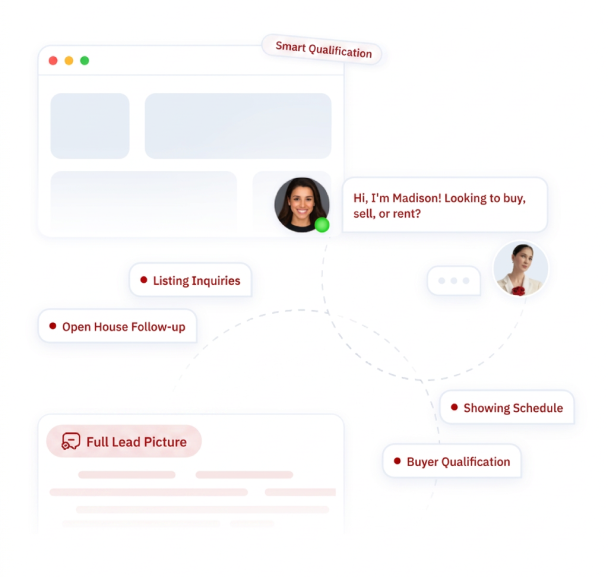
Answers Buyer FAQs
Instantly
Unit configurations, pricing, possession timelines, amenities answered accurately, immediately, every time.
The gap no one talks about

Unit configurations, pricing, possession timelines, amenities answered accurately, immediately, every time.
Understands buyer intent through conversation and surfaces serious prospects to your sales team.
Meets buyers where they already are — no new app, no friction.
No internet. No guesswork. Only the information you provide.
Tone, language and personality configured to match your brand.
Every conversation is captured and
ready for your team.
Ten inquiries at midnight. A hundred at launch weekend. No queue. No delay.
The question every developer asks
Your AI Sales Assistant is trained exclusively on the data you provide. It doesn't search the internet. It doesn't improvise. If a buyer asks something outside its knowledge, it says so and routes them to your team.
You control what it says.
Your buyers stay informed.
What changes
Your AI assistant handles every inbound inquiry instantly so your sales team spends less time on repetitive questions and more time closing deals.
The process
Simple, fast, no technical overhead on your end:
Share your project details, FAQs, brochures, and brand guidelines.
We configure the AI onGoes live on your WhatsApp Business number and project website.
Tested, approved,Leads engaged, questions answered, prospects qualified.
Your team focuses on visits and closings.Built for
with active or upcoming project launches
managing high inquiry volumes across multiple channels
who want better-quality conversations,
not more cold calls
targeting NRI buyers across time zones

What is an AI chatbot for real estate?
An AI chatbot for real estate is a conversational assistant that responds to property enquiries in natural language, answers questions about price, location, availability and payment plans, qualifies the buyer, and books site visits directly into the sales calendar.
Unlike the button-menu bots of a few years ago, current versions understand free-text questions, handle Hindi, Hinglish and English in the same conversation, and pull live inventory and pricing rather than reciting a fixed script.
Its job is narrow and specific: be the first responder. It covers the window between a buyer submitting an enquiry and a salesperson actually calling, which in most developer funnels is measured in hours and often never closes at all.
How does a real estate AI chatbot work?
A real estate AI chatbot works in five steps:
Trigger. A buyer fills an ad form, messages your WhatsApp number, or opens web chat, and the bot engages within seconds.
Understand. A language model interprets the question, whether it is typed in English, Hindi or a mix, and matches it against your project knowledge base.
Answer and qualify. It responds with accurate project details while working in the questions that establish budget, timeline, configuration and location preference.
Score and route. The conversation is scored for intent and pushed into your CRM with full context, assigned to the right salesperson.
Book or nurture. Ready buyers are offered site visit slots. Everyone else enters an automated follow-up sequence.
The knowledge base is what determines quality. A bot loaded with your actual price list, floor plans, payment schedules, possession dates and locality details performs well. One given only a brochure PDF answers vaguely and loses buyers.
What can an AI chatbot for real estate do?
A real estate AI chatbot handles eight core jobs:
Instant first response. Replies within seconds, at any hour, including nights and weekends when most property browsing happens.
Answer project questions. Price, configuration, carpet area, possession date, payment plan, amenities, approvals and location.
Qualify the buyer. Establishes budget, timeline, configuration need and purchase intent in conversation rather than through a long form.
Share collateral. Sends brochures, floor plans, price sheets, walkthrough videos and location pins on request.
Book site visits. Offers available slots and writes the appointment straight into the sales calendar.
Route to the right salesperson. Assigns by project, language, location or lead score, with the full conversation attached.
Follow up automatically. Runs multi-day sequences for buyers who go quiet, and re-engages cold leads against new launches or price revisions.
Capture data. Logs every question asked, which reveals what buyers actually care about and what your marketing is failing to explain.
What is the difference between a rule-based chatbot and an AI chatbot?
A rule-based chatbot follows a fixed decision tree and can only handle questions its builder anticipated. An AI chatbot uses a language model to understand intent, so it can answer questions that were never explicitly scripted.
The practical difference shows up immediately. Ask a rule-based bot "is there anything under 60 lakhs facing the park" and it offers you a menu. An AI bot understands the budget constraint and the orientation preference and answers both.
Rule-based bots still have a place for strictly transactional flows where the path is genuinely fixed. For property enquiries, where buyers ask unpredictable questions in unpredictable phrasing, they frustrate more people than they help.
What is the difference between a chatbot and an AI agent?
A chatbot answers questions. An AI agent takes actions. The distinction matters because a bot that can only talk still leaves your team doing the work of scheduling, updating records and triggering follow-up.
An agent checks live inventory, writes to the CRM, books a calendar slot, sends a brochure, assigns a salesperson and triggers a reminder sequence. Each of those is an action against another system, not a message.
For real estate, the agent version is the one worth deploying. Conversation without action produces a transcript nobody reads and a lead that still sits unattended.
Do real estate chatbots actually work?
Yes, on a specific and measurable job: closing the gap between enquiry and first contact. In most developer funnels a significant share of leads are never contacted at all, and a large share of the rest are contacted hours later, by which point the buyer has engaged with a competitor.
The mechanism is simple rather than magical. The same ad spend produces the same leads, but a much higher proportion of them get into a real conversation, and conversations are what produce site visits.
Where chatbots fail is when they are deployed as a substitute for the sales team rather than as a front end for it. A bot that will not hand a serious buyer to a human, or that answers vaguely because nobody loaded real project data into it, performs worse than no bot at all.
Will buyers actually talk to a chatbot?
Yes, and engagement rates are consistently higher than most developers expect, particularly on WhatsApp. Buyers researching property at 11pm want an answer, not a promise that someone will call tomorrow.
The behaviour has shifted. Many buyers now prefer messaging over a phone call in the early research stage, because it is lower pressure, they can browse at their own pace, and they are not committing to a sales conversation before they have basic information.
Resistance appears when the bot is obviously evasive, loops, or refuses to give a price. Buyers tolerate a bot that is useful and abandon one that is clearly stalling them.
Should a real estate chatbot say it is AI?
Yes. Disclosing that the assistant is automated builds more trust than pretending otherwise, and buyers generally work it out within a few exchanges regardless.
The better framing is functional rather than apologetic. Introducing the assistant as something that can answer instantly and connect them to the sales team when they are ready sets an accurate expectation and makes the handover feel like an upgrade instead of a reveal.
Regulatory pressure is also moving this way. Disclosure requirements for AI interactions are tightening in several markets, and building the practice now avoids a retrofit later.

