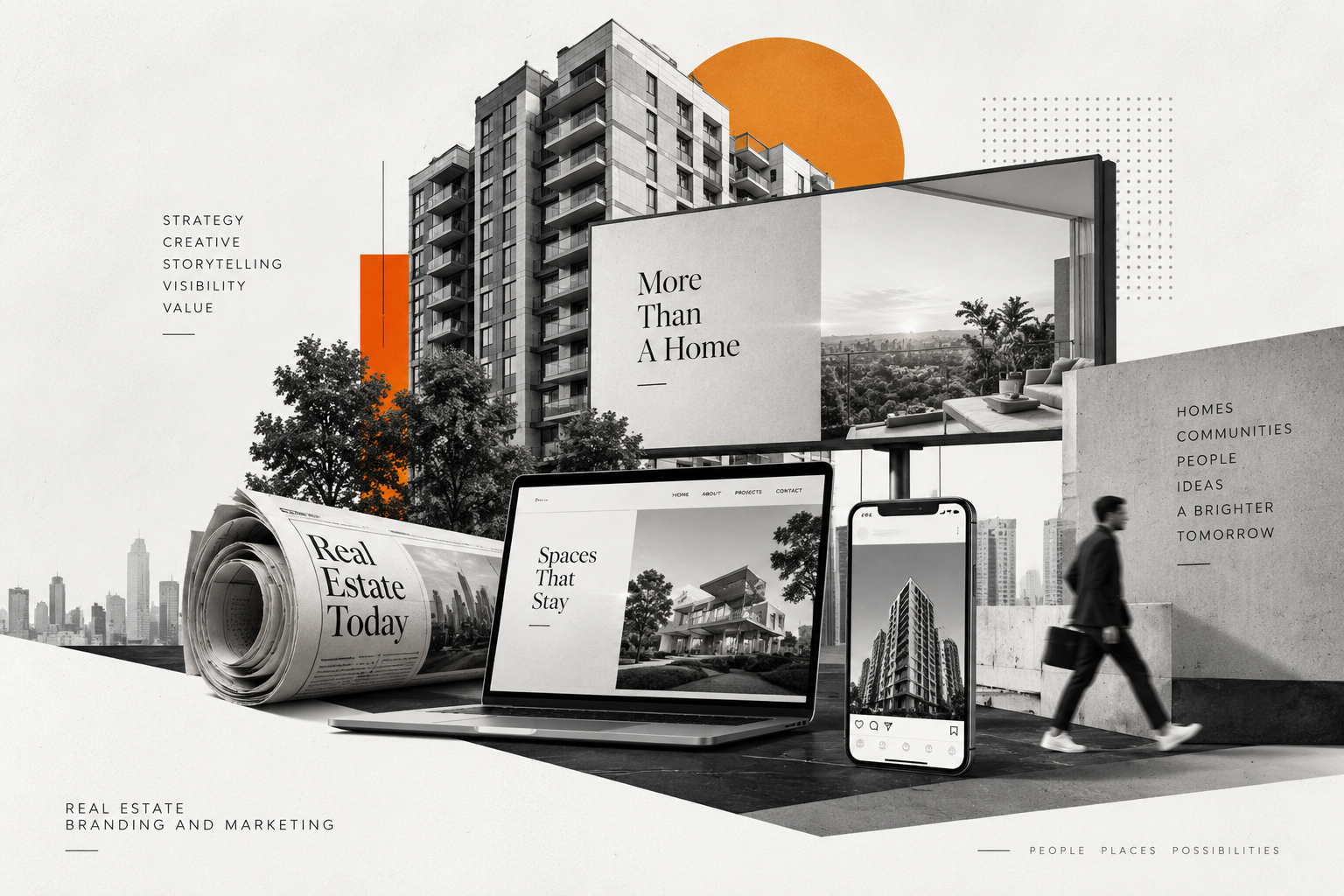
A buyer forms an impression long before they step into a sales office. It begins with a hoarding glimpsed from a moving car, an Instagram ad they barely registered, a brochure forwarded by a friend, or a project name they have heard twice but cannot quite place. By the time they visit the website, much of the groundwork has already been laid.
That is the real work of real estate marketing and branding. It shapes perception before the sales conversation begins. And too often, it only gets the attention it deserves once the enquiries begin to thin.
What Real Estate Marketing and Branding Actually Mean
Marketing and branding are often spoken of as though they are the same discipline. They are connected, certainly, but they solve different problems.
Branding establishes what a project means in the mind of its audience. It gives the development a position, a personality and a reason to be remembered. It sits behind the name, the identity, the narrative, and the idea a buyer eventually carries home and repeats to someone else.
Marketing takes that idea into the world.
It decides how the brand appears in a campaign, a search result, a social feed, a newspaper, a hoarding, a sales presentation, or the experience of walking into the site itself. Branding without marketing remains an idea sitting in a strategy document. Marketing without branding becomes a stream of communication with nothing particularly distinctive holding it together.
This is why good real estate branding begins before the logo.
Brand strategy and positioning ask a more difficult question: what should this project be known for? The answer comes from understanding the audience, the competitive set, the market and, most importantly, the truth within the asset that can be owned rather than borrowed from every other project around it.
Identity then gives that position a recognisable form. The logo matters, but so do colour, typography, imagery, language and tone. A buyer should be able to encounter the project across three different touchpoints and still feel that the same brand is speaking to them.
Campaign strategy determines how that identity travels. Digital, outdoor, print, content, performance media, and on-ground communication each have a role. Sales communication then carries the same thought into brochures, films, presentations, experience centres, and site branding.
The objective is simple: the project should tell one coherent story, even when the medium keeps changing.
What Tools Are Used for Real Estate Marketing?
Technology has changed the machinery behind real estate marketing considerably. But the presence of more tools has not necessarily made marketing more intelligent.
A CRM can organise thousands of leads. Analytics can tell you exactly what happened after someone clicked an ad. Automation can follow up with a prospect six weeks after the first enquiry. None of these can decide what the project should stand for.
That decision comes first.
CRM and lead-management systems are particularly important in real estate because the first enquiry is rarely the end of the process. Tracking response times, follow-ups, site visits and eventual conversions can reveal much more about campaign quality than a large lead count ever will.
Digital advertising platforms serve different stages of intent. Search can capture someone actively looking for a property. Social can introduce a project to someone who has not started searching yet. Retargeting can bring back the person who visited the website, looked at the floor plans, and disappeared.
The mistake is treating every channel as a digital noticeboard and repeating the same message everywhere.
Analytics and reporting tools have a similar role. They should connect marketing activity to actual business movement. A campaign generating the cheapest leads is not necessarily producing the most useful leads. Cost per enquiry and cost per qualified prospect can tell two very different stories.
Then there are the visual tools: architectural CGI, films, walkthroughs, renders and virtual experiences. These allow a buyer to understand a project before the concrete has risen from the ground. But technology cannot rescue an empty idea. A beautiful render is still only a beautiful render if there is no larger story giving it meaning.
Marketing automation keeps that story alive during the long consideration period. Email, WhatsApp, and retargeting can bring a project back into consideration without forcing a sale every time. The distinction matters. Staying relevant is very different from repeatedly asking someone whether they are ready to buy.
Strategy Comes Before the Software
It is entirely possible for a developer to have a CRM, paid media, analytics, automation, a polished website, and a sizeable marketing budget and still struggle to create demand.
The problem is rarely a missing tool. Tools answer the question of how something gets done. Strategy answers what needs to be said, who needs to hear it, and why they should care.
That is why the better real estate marketing conversations do not begin with, “Which platform should we run next?” They begin with the project. What is entering the market? Who is it really for? What are buyers comparing it with? What perception already exists? What is stopping the project from being considered? Once those questions have been answered, the tools become much easier to choose because they have a job to do.
What Should You Look for in a Real Estate Marketing and Branding Agency?
A portfolio can show you what an agency has made. It cannot always show you how well the agency thinks. Real estate is a peculiar category. The sales cycle is long, the ticket size is large, trust carries enormous weight, RERA shapes communication, and location influences the conversation almost immediately. A good agency needs to understand these realities before it starts proposing creatives.
Pay attention to the questions an agency asks. Does it want to understand the business before discussing deliverables? Does it ask why the project is struggling to gain attention? Does it want to know who the actual buyer is, what competing developments are saying, and what the sales team is hearing on the ground? Or does the first conversation arrive with a ready-made list of posts, films and advertisements?
The difference is telling.
Branding should also have a relationship with sales. If a sales team has to explain from scratch why a project is different every time the phone rings, the communication preceding that call may not be doing enough work. The right agency should be able to connect perception with business objectives, not treat branding as something that ends once the identity is approved.
What Do Commercial Real Estate Marketing Firms Do Differently?
Commercial real estate operates under a different set of buying pressures.
An investor may be examining rental yield and appreciation. A retailer may care about visibility, footfall, frontage and the surrounding catchment. A business tenant may be thinking about access, parking, workforce movement and proximity to other commercial hubs.
Emotion still exists. It simply has to share the room with evidence.
That is why commercial real estate marketing firms need a deeper understanding of the asset they are selling. An office development, retail destination, and industrial park cannot be reduced to the same marketing formula with different imagery. Each has a different audience. Each has a different decision-making process. And each requires a different hierarchy of proof.
Good commercial marketing knows when to create a desire for the project and when to present evidence. A buyer looking at an investment spreadsheet is unlikely to be convinced by adjectives alone.
What Should a Commercial Real Estate Marketing Package Include?
There is no universal commercial real estate marketing package. The requirements of a retail destination can be entirely different from those of an office development or industrial asset. A strong package usually begins with research.
Market research and competitor analysis establish what already exists, what the category is saying, and where an opportunity for differentiation might exist. Positioning follows, defining the reason the asset deserves attention in a market where buyers already have alternatives. Then brand naming and identity give the project its own vocabulary.
Then comes communication: campaigns, website, brochure, film, presentations and content. Digital marketing and lead generation bring the proposition into active search and consideration. Sales enablement carries it into investor decks, sales collateral, and the on-site experience.
Measurement closes the circle. Lead quality, site visits, engagement, and conversion patterns tell the team whether the communication is actually contributing to the business. The important thing is that these elements should not exist as a checklist. Each should have a purpose, and each should follow logically from the decision before it.
Should You Work with One Agency or Several Specialists?
There is a case for specialist agencies. A branding studio may bring deep identity expertise. A performance team may bring specialised media knowledge. A PR firm may have relationships and experience that another agency does not.
The challenge appears when these specialists begin telling different versions of the same story. The website sounds one way. The brochure sounds another. The performance campaign develops a third personality. The buyer moves between them without consciously analysing the inconsistency, but the brand begins to feel fragmented. One agency carrying strategy through execution can reduce that friction, provided it has the depth to handle both.
The real question is less about agency size and more about whether the people deciding what the brand should say are close enough to the people actually making it.
Five Questions to Ask Before Choosing an Agency
Ask whether they understand real estate as a category or simply as another client vertical. Ask whether they begin with diagnosis or deliverables. Ask whether they can position a project or only promote it. Ask whether their work changes meaningfully from one client to another or simply changes colour. And ask them how they believe branding eventually shows up in sales. The answers will tell you considerably more than a polished portfolio presentation.
How Nine Degree Approaches Real Estate Marketing and Branding
At Nine Degree, branding and business thinking begin at the same table.
The starting point is not how many posts a project needs or which platform should receive the next campaign. It is understanding what the project needs to mean, who it needs to mean something to, and what the business is trying to achieve.
The work can span strategy, positioning, identity, campaigns, digital communication, sales collateral, and on-ground experience. The combination changes because every project enters the market with a different set of circumstances.
Sometimes the challenge is perception: a developer has grown considerably, but the brand still communicates the scale it had years ago. Sometimes it is a new project entering a crowded market and needing a distinctive place in the buyer's mind. And sometimes the problem sits between marketing and sales, in the space between what a campaign promises and what a buyer actually experiences. That is where our work becomes more interesting.
The Best Marketing Is Not the Longest List of Deliverables
The tools matter. The campaigns matter. The agency matters. But clarity comes first.
Because when the positioning is right, every subsequent decision becomes sharper. The campaign knows what it needs to say. The creative knows what it needs to make visible. The sales team knows what it needs to reinforce. The buyer begins to encounter the same idea in different forms rather than a collection of disconnected messages.
Real estate is too competitive for communication pulling in five directions at once. A stronger brand does not necessarily need more noise. It needs a clearer reason to be noticed, remembered, and considered. That is the conversation Nine Degree believes should happen before the next campaign begins.
Let's build your real estate brand.
Frequently Asked Questions
What is real estate marketing and branding?
Real estate branding defines how a developer or project is positioned, perceived, and remembered. Real estate marketing takes that positioning into the market through campaigns, digital media, content, sales collateral, outdoor advertising, and other communication channels. The two work together, but they serve different purposes.
What tools are used for real estate marketing?
Common tools include CRM and lead-management platforms, search and social advertising platforms, analytics and reporting systems, marketing automation, content-management systems, CGI and visualisation tools, email and WhatsApp platforms, and retargeting technology. The right combination depends on the project's audience, sales cycle and objectives.
What does a real estate marketing agency do?
A real estate marketing agency can work across positioning, branding, campaign strategy, digital marketing, content, performance media, sales collateral, website communication, and on-ground branding. The scope depends on what the developer or project actually needs.
How do commercial real estate marketing firms differ from residential agencies?
Commercial real estate marketing usually has a stronger emphasis on evidence such as yield, footfall, catchment, tenant mix, access, visibility, occupancy potential and investment fundamentals. Residential marketing can lean more heavily into lifestyle and emotional aspiration, although both require a clear understanding of their audience and buying behaviour.
What is included in a commercial real estate marketing package?
A commercial real estate marketing package may include market and competitor research, positioning, naming and identity, campaign strategy, website and brochure development, digital marketing, lead generation, investor or sales presentations, on-ground branding and performance measurement. The exact mix should be determined by the asset and its commercial objective.
How do you choose the right real estate marketing agency?
Look beyond the portfolio. Examine how the agency approaches strategy, how well it understands real estate, the questions it asks before proposing work, the thinking behind its past projects, and its ability to connect brand communication with business and sales objectives.
Why is branding important in real estate?
Property is a high-consideration purchase, and buyers encounter several projects before making a decision. Strong branding gives a project a recognisable identity and a clear reason to be remembered, helping create consistency across the many touchpoints that shape perception before a site visit or sales conversation.
Share