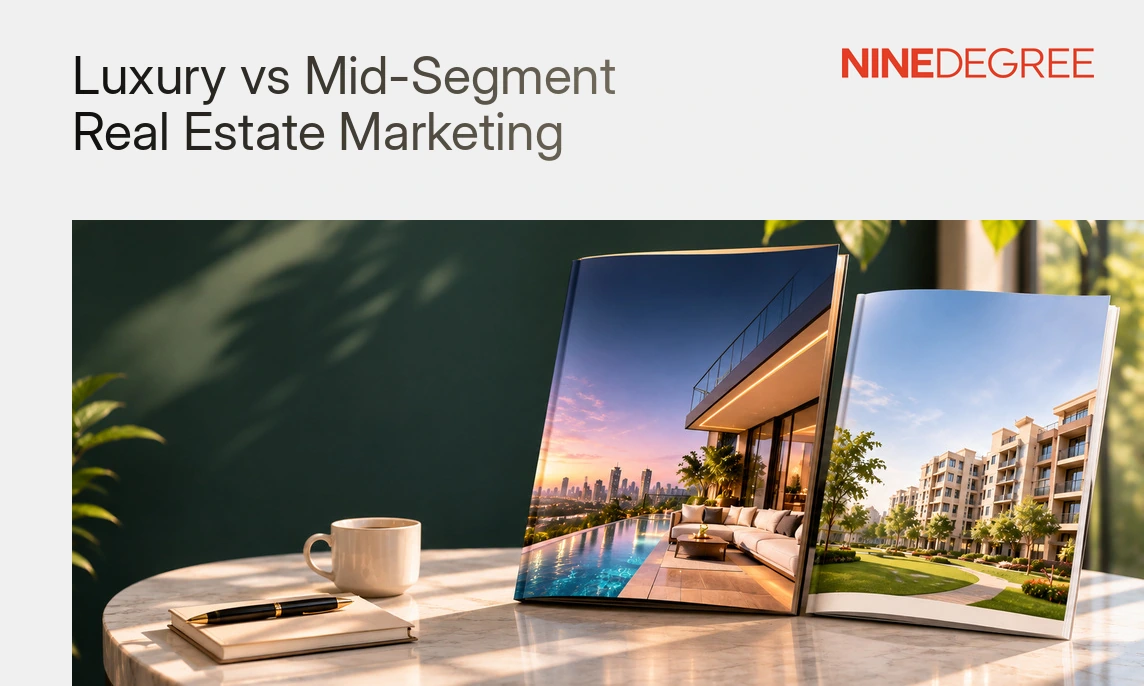
Understanding the Difference Between Luxury and Mid-Segment Real Estate Marketing
A family looking for its first apartment may spend an evening comparing two projects on price, location, floor plans and monthly payments.
A high-net-worth buyer considering a luxury residence may spend that same evening looking at the architect, the privacy between apartments, the quality of materials and whether the address reflects the life they have built.
Both are buying real estate. Both need convincing. But the reasons that move them towards a decision are considerably different.
This is where real estate marketing often gets its approach wrong, whether the work sits with an in-house team or a real estate marketing company. A developer may have a luxury project and a mid-segment project running through the same marketing playbook, with a different colour palette, a higher production budget and a few premium words added to the copy.
That rarely changes the quality of the conversation.
Luxury and mid-segment real estate require different judgements about what to communicate, where to communicate it and how to make the project worth considering. To understand how luxury real estate marketing differs from mid-segment marketing, it helps to look at the decisions behind each campaign.
The Buyer Is Different, and So Is the Argument
Real estate purchases involve considerable money, family discussions and long-term expectations. However, the questions that occupy a buyer's mind change with the kind of property being considered.
A mid-segment buyer may want to know whether the property fits the family's budget, whether the location makes everyday travel manageable and whether the developer can deliver what has been promised.
A luxury buyer may already have a home and is considering a move that offers something beyond additional space. The questions shift towards design, privacy, exclusivity, craftsmanship, neighbourhood and the quality of everyday living.
This distinction matters because marketing has to answer the questions that actually influence the purchase.
A campaign that spends its entire budget showing a luxury apartment's square footage may communicate the size of the product without explaining why the experience deserves a premium. Similarly, a mid-segment campaign that spends too much time talking about an abstract lifestyle may leave a buyer waiting for the price, location and practical details.
The product sets the price. The buyer's reasons for choosing it determine the message.
6 Areas Where Luxury and Mid-Segment Real Estate Marketing Differ
1. Positioning: Sell a Way of Life or Make a Strong Practical Case?
A mid-segment project usually has to make a clear case for the purchase. The buyer wants to understand what the property offers in relation to its price, location and everyday requirements.
A campaign may lead with a well-connected address, practical floor plans, family amenities or a payment plan that makes the purchase manageable. These are tangible reasons that help a buyer compare projects.
Luxury positioning works differently. The buyer is rarely looking at the number of amenities alone. They want to understand what makes the property distinct from other homes available at a similar price.
Consider two residential projects offering four-bedroom apartments.
The mid-segment project may communicate the advantage of a well-planned four-bedroom layout, proximity to schools and daily conveniences, and facilities that serve the entire family.
The luxury project may focus on the architect's approach, the privacy of each residence, the materials used in the interiors, the views from the apartment and the experience of returning home.
Both projects have four-bedroom apartments. Their positioning gives the buyer two very different reasons to consider them.
A luxury project must establish what makes its offering worth choosing. A mid-segment project must establish why its offering makes sense.
2. Messaging: Specific Advantages Over Broad Lifestyle Claims
The language used in real estate advertising often becomes repetitive. Every project promises a better lifestyle, every apartment is a dream home and every development offers world-class amenities.
These expressions do very little to distinguish one project from another.
Mid-segment communication benefits from clarity. Buyers want to know what they are getting, and the copy should make those details easy to understand.
Instead of saying "A lifestyle designed around your family", a campaign can talk about the practical advantages of a three-bedroom layout, a dedicated children's play area or the distance to an important workplace.
Luxury messaging needs a different kind of precision. It can afford to be more restrained, but it cannot afford to be vague.
A line about privacy becomes more meaningful when supported by fewer residences per floor, separate access arrangements or a carefully planned apartment layout. A statement about craftsmanship needs details about the materials, finishes and people behind the design. That was the thinking behind our work for Sawai, a luxury residence in Jaipur, where the story rested on its stone facades, handcrafted jharokhas and restored antique doors rather than on adjectives.
The difference is not that luxury communication uses fewer facts. It chooses facts that carry a different kind of value.
A mid-segment buyer may respond to a clear explanation of what the project includes. A luxury buyer may respond to the thought and detail behind how those inclusions have been selected.
3. Media Selection: Reach the Market or Reach the Right People?
The media plan for a real estate project should follow the audience's habits and the kind of decision the developer wants to influence.
For mid-segment housing, a wider reach often makes sense. The potential buyer pool can be spread across several neighbourhoods, income groups and family situations.
Meta advertising, Google Search, property portals, outdoor advertising, local publications and channel partner networks can all contribute to discovery and enquiries.
The campaign needs to create enough visibility while keeping a close watch on the quality and cost of leads.
Luxury real estate marketing has a more selective media requirement. A large number of impressions may look encouraging in a campaign report, but they do not necessarily bring the project closer to the right buyer.
A considered media mix may include premium publications, carefully selected digital audiences, private previews, business and social networks, high-quality editorial placements and personal introductions through channel partners.
Digital advertising still has a role. Search campaigns can reach people actively exploring premium property, while social campaigns can introduce the project to relevant audiences and support repeated exposure.
The important distinction is how success is measured. A luxury campaign should pay attention to the quality of enquiries, the relevance of the audience and the movement from initial interest to a site visit. Mid-segment campaigns usually have a stronger emphasis on reach, lead volume and conversion efficiency.
The right media plan is the one that reaches the people who can actually consider the purchase.
4. Creative Direction: Show the Product or Show the Experience?
Creative work is where the difference between the two segments becomes especially visible.
A mid-segment campaign generally benefits from clear product communication. The apartment, its layout, the amenities, the location and the price advantage need enough space to be understood.
The visual hierarchy should make information easy to find. Floor plans should be readable, amenity images should explain what is available and the headline should give the buyer a reason to enquire.
Luxury creative needs a different visual discipline. The work has to communicate the quality of the offering before the buyer starts reading the specifications.
Consider an advertisement for a luxury residence.
A conventional layout may place the project render in the centre, surround it with amenity icons and add a list of features along the bottom. It communicates information, but it may not communicate the character of the property.
A more considered creative direction may use one strong architectural photograph, restrained typography, a carefully chosen headline and enough white space to let the visual speak. For more on how this plays out across formats, see these luxury apartment advertising ideas that attract high-net-worth buyers.
The same principle applies to video. A mid-segment film may take the viewer through the apartment, amenities, connectivity and family conveniences. A luxury film may spend more time on material details, natural light, spatial planning, landscaping and the experience of moving through the residence.
Neither approach is automatically better. The creative must make the product understandable in the way its buyer expects to experience it.
5. The Buying Journey: Generate Enquiries or Build Confidence Over Time?
A mid-segment buyer may begin with a property portal, see a social media advertisement, submit an enquiry and visit the sales office within a relatively short period.
This does not mean the decision is simple. Family members may compare several projects, discuss finances and revisit the property before making a booking.
Marketing needs to support this process with clear information, timely follow-ups, site visits and communication that addresses practical concerns.
Luxury purchases can involve a different sequence of interactions. The buyer may encounter the brand through a publication, a personal introduction or a private event before enquiring about the property.
They may take more time to understand the developer's reputation, the design credentials and the level of service offered. A site visit may involve a more personal presentation, and the experience itself becomes part of the decision.
This is why a luxury project cannot rely entirely on lead forms and automated follow-ups.
Personal communication, carefully planned previews, detailed presentations and a sales team that understands the product can carry considerable weight.
The marketing team has to consider what happens between the first impression and the final decision, rather than treating the enquiry as the end goal.
6. Budget and Performance: Spend Differently, Measure Differently
The difference between luxury and mid-segment marketing also affects how the campaign budget should be planned.
A mid-segment project may need sustained spending across performance campaigns, outdoor visibility, property portals, channel partner activities and local market communication.
The campaign has to maintain a steady flow of relevant enquiries while monitoring the cost of acquiring them.
Luxury marketing may allocate a greater share of its budget to brand experiences, premium creative production, editorial placements, private events and personalised buyer interactions.
This does not mean performance advertising has no place in luxury real estate.
Google Search can capture existing demand. Meta can help introduce a project to relevant audiences. Retargeting can bring interested visitors back to the project website or campaign material.
However, the campaign should not be judged by lead volume alone. A lower number of relevant enquiries may be more useful than a large number of enquiries from people who cannot consider the property.
Similarly, mid-segment marketing should not focus on low cost per lead without examining lead quality and actual bookings.
A marketing report must reflect the commercial reality of the project. The number of leads, site visits, qualified prospects and bookings all tell different parts of the story.
Should Luxury Real Estate Projects Use Performance Marketing?
Yes, but the campaign needs a clear role for it.
Performance marketing is useful when the project needs to capture active property searches, introduce itself to relevant audiences or bring interested visitors back for another interaction.
For instance, someone searching for luxury apartments in a particular part of Jaipur may already have a reasonably clear idea of the property they want. A well-planned search campaign can bring the project into that consideration.
Social media can serve a different purpose. It can introduce the architecture, the residences and the developer's approach to an audience that may not be actively searching at that moment.
The mistake is expecting every interaction to produce an immediate enquiry.
Luxury purchases often involve several touchpoints before a buyer decides to make contact. Performance campaigns should therefore work alongside the brand's wider communication, rather than carry the entire launch.
A good campaign knows when to ask for an enquiry and when to give the buyer another reason to remember the project.
What Should a Real Estate Developer Consider Before Planning a Launch?
The marketing approach should be decided before the campaign enters production. A few questions can prevent a great deal of wasted effort later.
Who is the actual buyer? Understand their purchase motivation, financial considerations, existing property ownership and expectations from the project.
What makes the project worth considering? Identify the features and advantages that genuinely distinguish it from competing developments.
What should the buyer remember? Establish one central positioning thought that can guide advertisements, films, brochures, website content and sales presentations.
Which channels can reach this buyer? Select media based on audience behaviour and the role each channel has in the buying journey.
What should the creative communicate? Decide whether the campaign needs to lead with price, product details, architecture, experience or a combination of these.
How will the campaign be evaluated? Agree on the measures that matter, from reach and enquiries to qualified leads, site visits and bookings.
These decisions are particularly important when a developer has projects across different price segments. A common brand identity may connect the developments, but each project needs a marketing argument of its own.
The Difference Begins Before the First Advertisement
Luxury and mid-segment real estate marketing may use many of the same tools. Both need a website, social media, performance advertising, brochures, outdoor communication and a sales team that can carry the conversation forward.
What changes is the judgement behind their use.
A mid-segment buyer needs enough clarity to compare the property with other options and understand its practical value. A luxury buyer needs enough reason to see the property as distinct from other homes available to them.
Neither requires more adjectives. Both require a sharper understanding of what the buyer is looking for.
A campaign can have expensive production, a large media budget and a polished visual identity, yet still struggle if it cannot answer that basic question.
The product may have fifty things worth communicating. The work of marketing is to decide which of them matter most to the person making the purchase.
And that is where Ninedegree usually starts, whether the brief is a mid-segment residential launch or a luxury development. If a project is going to market, talk to our team about building a marketing strategy around the product, the buyer and the reason to choose it.
Frequently Asked Questions
1. How is luxury real estate marketing different from mid-segment marketing?
Luxury real estate marketing places greater emphasis on design, exclusivity, privacy, craftsmanship and the overall residential experience. Mid-segment marketing generally focuses more on price, location, floor plans, amenities and practical advantages. Both require clear positioning, but the reasons used to influence the purchase differ.
2. Which channels work best for high-end property buyers in India?
The choice depends on the project's location, price point and target audience. Premium publications, curated events, personal networks, property portals, Google Search and carefully planned social media campaigns can all contribute. A combination of selective offline exposure and targeted digital communication can help reach relevant buyers.
3. Should luxury projects run performance ads at all?
Yes. Performance advertising can help luxury projects capture active property searches, introduce the development to relevant audiences and support retargeting. However, campaign success should also consider enquiry quality, site visits and qualified prospects rather than relying only on lead volume.
4. How do luxury buyers' decision journeys differ from first-time buyers?
First-time buyers often spend considerable time evaluating affordability, location, loan requirements, floor plans and family needs. Luxury buyers may place greater emphasis on design, privacy, developer credentials, materials and the experience offered by the property. Both involve careful consideration, although the questions and interactions along the way may differ.
5. What is a good marketing strategy for a luxury real estate launch?
A good strategy begins with a clear understanding of the buyer and the project's distinct advantages. It brings together considered positioning, strong visual communication, relevant media selection, premium project presentations, targeted digital campaigns and personalised sales interactions. The objective is to build confidence and attract qualified buyers throughout the purchase journey.
Share