A buyer fills in a lead form at 11 pm on a Tuesday, between a cricket highlight and three other projects. The sales team calls the next afternoon. The phone rings out, and the lead moves to a column called "follow up later". By the time later arrives, the buyer has watched two competitor walkthroughs and stopped thinking about this project.
Developers pay for that gap every month, usually under the label of poor lead quality. A good part of it is a response problem. Property is a long decision, with loans, family opinions, and a dozen comparisons between enquiry and booking, and the brand that stays present through those weeks usually earns the site visit.
WhatsApp marketing automation is the most practical way to stay present at scale. The buyer is already on the app and replies there faster than to an unknown number.
A Phone Call Cannot Hold a Buyer for Months
Most sales processes assume every prospect is ready to talk when the team is ready to dial. One buyer is waiting on a loan. Another is persuading a parent. A third is torn between a 2 BHK now and a 3 BHK next year. All three submitted the same form on the same day, and all three need different things over the next six weeks.
Lead generation gets judged on cost per lead, and the leak sits further down, in the silence after the form. Our piece on setting up a real estate conversion system covers the connected view. WhatsApp is the channel that keeps it moving day to day while the sales team works the buyers who are ready now.
What WhatsApp Automation Marketing Actually Does for a Project
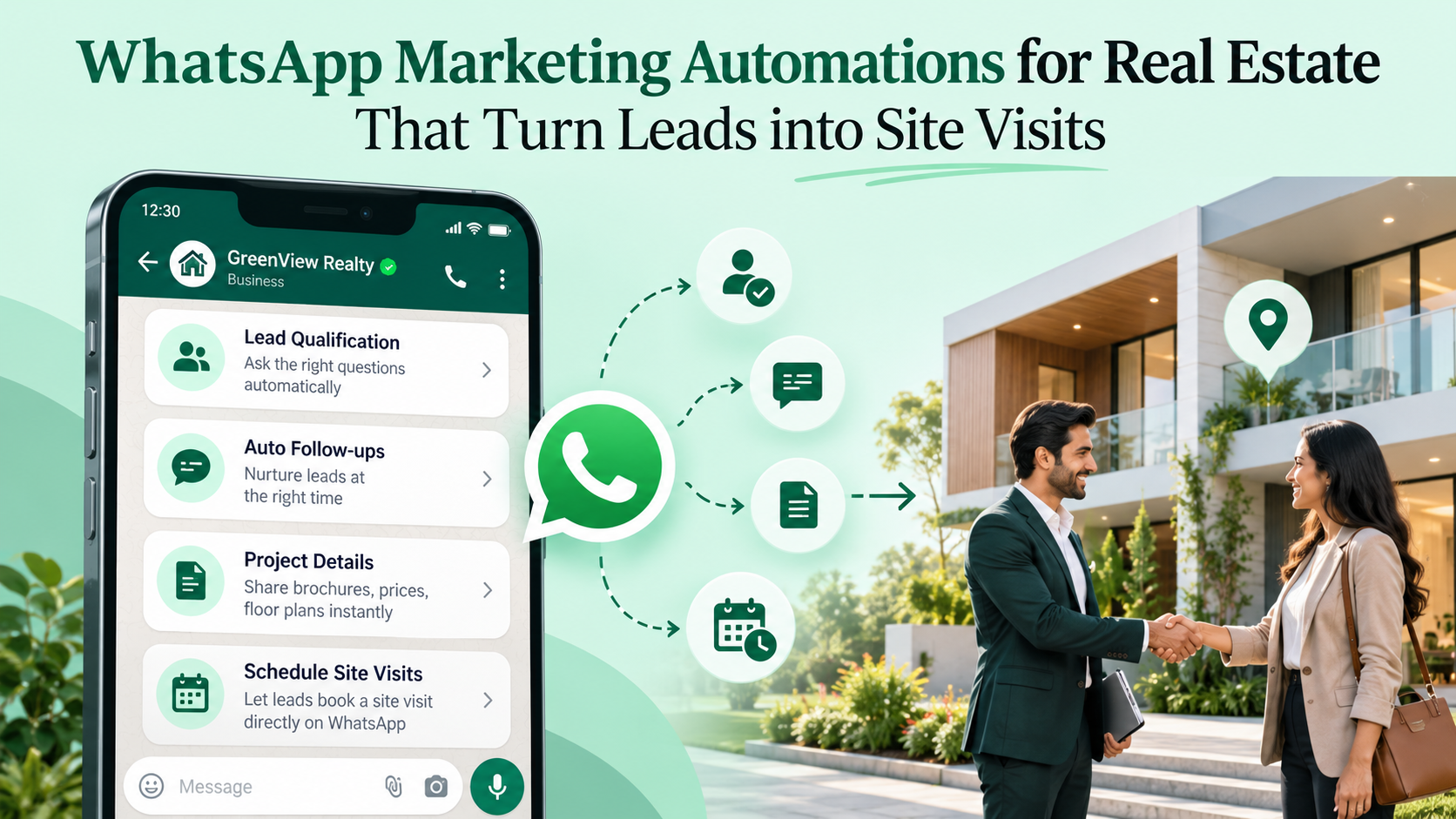
A buyer taps a click-to-WhatsApp ad for a new launch. Within a minute, a message asks what they would like to see first: the brochure, floor plans, or price. They choose, the brochure lands, and a short question about configuration follows. The answers go into the CRM, and a salesperson is assigned with the conversation attached.
That is WhatsApp automation marketing in practice. Workflows, approved templates, chatbot logic, and CRM triggers handle the repetitive part of a conversation so people can handle the rest. A bot alone is a novelty. The value shows up when the lead source feeds the CRM, the CRM triggers WhatsApp, and the chat feeds qualification back, ending in a booked visit. Developers who treat marketing automation on WhatsApp as a standalone tool end up with a fancier inbox. The rest end up with a pipeline they can read.
Let the Bot Ask the Boring Questions
A WhatsApp business bot earns its place in a lead's first ten minutes. Open questions like "How can we help you?" get ignored. Simple choices get answered. Which configuration, what budget range, when are they buying, living or investing, and would they like to see the project this weekend?
Three to five questions are enough. Longer starts to feel like a government form.
The payoff reaches the salesperson. A buyer who has said "3 BHK, this budget, within two months, Saturday works" is a different call from someone who downloaded a brochure out of curiosity. The salesperson opens with a proposed time instead of introductions.
The bot should never pretend to be a salesperson, negotiate, or answer legal and pricing questions beyond what the developer has cleared. Qualification belongs to the bot. Persuasion belongs to people.
Drip Campaigns Reward Patience, If Each Message Earns Its Place
Not every lead should be pushed towards a visit on day one. Some need information first, and some need time. Real estate drip campaigns exist for them.
For anyone asking what a drip campaign in real estate is, it is a sequence of messages released over days or weeks, timed by when the lead entered and shaped by how they respond. Each message carries one useful thing.
Take a hypothetical 3 BHK enquirer. Day one brings the introduction and brochure. Two days later, a short note on why the location suits a daily commute. By day five, the floor plan, then a walkthrough video. Around week two, an invitation to see the apartment, followed by construction progress or new availability. Nothing clever, only relevance and spacing.
The sequence has to branch. A lead who books a visit moves to a visit workflow. A lead who keeps opening 3 BHK content gets more of it. A lead who goes silent gets fewer messages. Drip marketing in real estate becomes harassment the moment it ignores what the buyer is doing.
Length depends on the product. A ready-to-move apartment can justify a tight sequence over a couple of weeks. A high-ticket or under-construction project may need months of slower contact.
Email, Broadcasts and Drips Are Three Different Tools
A real estate drip email still has a job, mainly for content that does not belong in a chat window, such as specifications, investment notes, and construction newsletters. A real estate email drip campaign suits the buyer who wants to read properly at a desk. WhatsApp suits the quick answer, the reminder, the rescheduled visit.
The strongest setups combine them. WhatsApp delivers the floor plan, email follows with the full specification sheet, and WhatsApp returns with a question about Saturday.
WhatsApp broadcast marketing is a different thing. It sends one message to a chosen audience at one moment, like a private preview invitation to a qualified list. A drip is personal and unfolds from the day the lead entered. A developer with thousands of leads at different stages needs both, but a broadcast sent to the whole database wastes everything the CRM knows.
The CRM Decides Whether This Is a System or a Louder Inbox
Every WhatsApp message should leave a trace in the CRM: source, enquiry, bot answers, sales contact, visit, and what followed. Without that, WhatsApp is another disconnected inbox.
With it, the CRM reacts. A brochure request tags the lead as interested. Choosing 3 BHK starts the 3 BHK sequence. A visit request alerts sales. A completed visit triggers a follow-up, and thirty days of silence triggers a gentler message tied to something real, such as a new phase, fresh inventory, or a construction milestone.
A buyer who returns after three weeks finds a team that remembers the earlier conversation. For a purchase this large, that small act of memory outweighs most advertising.
What a Good Message Sounds Like
"Dear valued customer, we are pleased to inform you" has never moved anyone towards a site visit.
A better first message sounds like someone on the team wrote it. "Hi Rohan, thanks for your interest in the 3 BHK. Would you like the floor plan first, or would you rather see the apartment this Saturday?" It is short, offers a choice and ends on a question. That matters because a buyer's reply opens a 24-hour window in which the team can respond freely.
Outside that window, WhatsApp permits only pre-approved templates, and marketing templates are billed per message. Every sequence should be designed around that. "We missed you at the project today, would you like us to arrange another time this week?" works because it is brief and easy to answer. "Just checking if you're still interested" works for nobody.
Social Media Automation Belongs in the Same Loop
A buyer may find a project through a reel, watch a YouTube walkthrough, see a retargeting ad, visit the website and only then message on WhatsApp. That is one person making one decision.
Real estate social media automation handles scheduling well enough, but its worth shows when social activity connects to the same CRM and WhatsApp workflows, so the reel viewer arrives in the sales view as one lead with a history. Social creates attention. The connected system keeps hold of it.
Know When to Switch the Bot Off
Buyers eventually want a person who understands their circumstances. Automation should hand over early.
Message only people who have opted in, and record that consent. Skip the five follow-ups because a lead has not replied. Invent no urgency. Stop the sequence when a buyer asks for a human. Keep the bot away from legal status, approvals and pricing that the developer has not cleared, since a claim made in chat carries the same compliance weight as one made in an advertisement.
A system that knows when to be quiet is the one buyers tolerate for months.
Measure Movement, Not Message Counts
Messages sent and delivered always look healthy, and they say nothing about the business.
Better measures sit further down: first-response time, the share of conversations reaching qualification, cost per qualified lead, visit bookings, attendance, and visit-to-booking conversion, along with how many dormant leads come back and how long enquiry to first visit takes. The question shifts from "How many leads did the campaign generate?" to "How many qualified buyers did the system move closer to a site visit?" The second is harder to answer and far more useful to a sales head.
From Lead Generation to Lead Movement
The form fill is the start of a conversation, and most developers treat it as the end of a task. Advertising, landing pages, WhatsApp, CRM and sales produce results only when they behave like one machine. Automation handles repetition, data supplies context, and the sales team brings judgement.
At Nine Degree, we build real estate marketing as a connected system rather than a calendar of campaigns, and WhatsApp marketing automation is where that thinking becomes visible to a buyer. For the wider picture, read how WhatsApp is changing the path from enquiry to closure.
A project does not need more messages. It needs the right buyers to keep moving, one sensible reply at a time. If that is the problem on your desk, we would be glad to talk it through.
Frequently Asked Questions
What is a drip campaign in real estate?
A real estate drip campaign is a planned sequence of messages that reaches a prospect over days or weeks, timed by when they enquired and shaped by how they respond. Each message carries one piece of information, such as location, a floor plan or a walkthrough, so the buyer moves towards a site visit gradually. It can run on WhatsApp, email or both, and it stops once a salesperson takes over.
How do you automate WhatsApp follow-ups for property leads?
Connect every lead source to a CRM and to an approved WhatsApp Business Platform account, with the buyer's consent recorded. Then build workflows around triggers such as a new enquiry, a brochure request, a booked visit or thirty days of silence. Each trigger sends an approved template or reply and tags the lead, and any sign of high intent alerts the salesperson with the full conversation attached.
Can a WhatsApp chatbot qualify real estate leads?
It can, for the first layer. A WhatsApp business bot is good at collecting configuration, budget range, buying timeline, location preference and interest in a site visit, then passing those answers to the CRM. Negotiation, financing doubts and a family's hesitation still need a person. Qualification should be the bot's job, and persuasion should stay with the sales team.
How long should a real estate drip campaign run?
The length follows the sales cycle. A ready-to-move apartment may need two or three weeks of tight, visit-focused messaging, while an under-construction or high-ticket project can justify months of slower nurturing with periodic updates. Define stages and let buyer behaviour set the pace. Leads that stop responding should move to a lighter re-engagement track and leave the daily sequence.
What is the difference between a WhatsApp broadcast and a drip?
A broadcast sends one message to a chosen audience at one moment, such as a private preview invitation for a Saturday. A drip is a sequence that starts when an individual lead enters a workflow and continues according to their timing and responses. Broadcasts suit announcements and drips suit nurturing. Developers with large databases usually need both, with broadcasts built on segments the CRM has already sorted.
Share