A hoarding is read from a moving car.
A reel is seen, a thumb hovering over the next one.
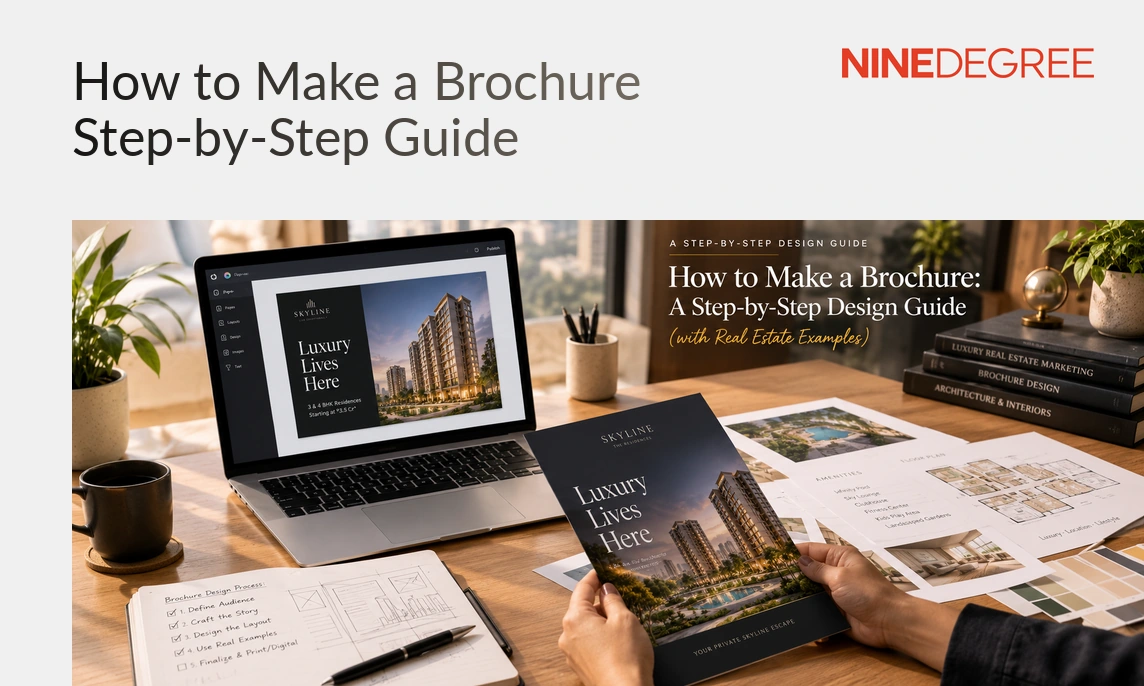
A brochure is one of the rare pieces of real estate marketing that is read slowly by numerous people in a room the developer will never see. It's spread out on a dining table, shot page by page, and sent to whatever relative handles the family's money matters.
This delayed joint reading is precisely why so many brochures are disappointing. Assembled in the home stretch before a launch with whatever copy was lying about and a layout that follows the order of the architect's designs rather than the order of the buyer's doubts. To learn how to produce a brochure that performs, the best way is to make decisions before opening any design tools; therefore, this article leads you through them sequentially using real estate scenarios along the way.
A Brochure Must Win the Arguments You Can’t Be There To Fight
A brochure in real estate is designed to take the sales conversation into locations the sales team cannot follow. When the buyer leaves the experience centre, the brochure answers anything that pops up at home: how far the school is, why this tower costs more than the one next door, who the developer is and what they have produced before.
It is there to recall, to comfort and to provide the customer the language to justify their choice to someone else.
An ad gets attention, and we've covered how to do that well in our guide to real estate ad design. A brochure has to work to win belief, which is a slower job and needs more proof on each page.
9 Steps to Creating a Brochure That Gets Read
1. Name the sections before naming the reader.
The brochure for an NRI investor sounds considerably different from that of a local family that is upgrading from a rented flat. The investor is looking for micro-market handover time lines, payment plans, legal clarity and rental stories. The family checks school distances, room sizes, safety, vastu and whether a bed and a study table can be accommodated in the second bedroom.
The answer is rarely two brochures, because most initiatives serve both. It’s a clear judgement on what questions get the cover story and the first three pages.
2. Find the one sentence the whole brochure says
Every project has fifty things to say and a brochure that says none of them say anything memorable. Determine what the project should be remembered for, and audit each page against that. For a plotted development in a growing highway corridor, that may be roads already there, clear ownership and the freedom to build your own home. Maybe it’s about every square foot being designed for a dense mid-segment apartment complex.
This is placement, and a brochure is a place where it either appears or goes quietly away. If the line cannot fit on the page, it must be placed in a distinct document.
3. Pick the format when you know the story.
A bi-fold is good for one simple offer, a tri-fold goes well via events and channel partner desks, and a booklet of twelve or more pages justifies its cost when the project has a number of towers, layered amenities or a long developer story. Format determines how much argument you can afford; therefore, choose it after the idea, never before. We’ve compared all three types in detail in a separate guide on bi-fold, tri-fold and booklet brochures.
4. Design page flow around buyer questions
Buyers prefer to ask what it is like before they question where it is and how much before who is developing it. Usually such a flow would begin with the cover idea and then move to site & connectivity, master plan, architecture & product, amenities, floor plans, specifications, developer credentials and ultimately RERA details and contact points.
Keep the price list as a detachable insert. Pricing can change over the life of a project, and a loose sheet means the brochure will not have to be reprinted every time it does.
5. Write copy before opening the design file.
The layout is dictated by the copy, and it is much easier to eliminate a line in a document than to modify a spread that was set around a paragraph that nobody wrote. Headlines should be something you can prove. A line based on a calculated drive time to the nearest ring road will inform the consumer more than the word ‘connectivity’ ever will.
Captions need the same discipline, because purchasers scan them more than body content. The old standbys, like "dream home" and "world-class amenities", are out. It’s the details that make a brochure look pricey.
6. Design for scanning, one concept per page spread
Design is the visual form of positioning; therefore, decorative decisions should be made by thought, not taste. Two fonts are enough. Use colours from the identity of the brand, one hero image to anchor each layout, and use white space with intent. A luxury villa building can afford to be generous with emptiness. To look organised and assured, a brochure for affordable housing must be based on clean facts, not ornamentation. Dignity in design is just as important in the mid-segment as it is in luxury.
Renders often take the longest to develop, so brief the visualisation team before the copy is signed off, and label every image as an artist's impression.
7. Consider floor plans and numbers as the trust pages.
If you asked anyone in a sales office what pages the buyers look at first, they would normally tell you floor plans. They should be clean, to scale, readable at print size and unambiguous regarding carpet area, which is the figure RERA intends to be offered to buyers. Add a north arrow, room measurements and the unit mix.
Brand names should be called out only if the developer is contractually obligated to do so. “The brochure should have the RERA registration number and mention the RERA web reference. Omit any claim about appreciation or returns.
8. Make 2 files, one for the press and one for the phone.
If you’re trying to figure out how to generate a brochure PDF, you should know there’s a difference between a print file and a screen file. Print version: CMYK colour, high quality, 3 mm bleed and crop markings, physical proof before the whole run. The digital version must be small enough to open on a mid-range phone over WhatsApp and must contain a clickable phone number, a location pin and a link to the inquiry form.
If you’ve done the steps above, tools like Canva are a good method to build your own brochure for a little broker or a pre-launch teaser. Launching a whole project demands a designer that can do plans, renderings and print production as a package.
9. Test it with your sales team before it hits the printer.
Hand the manuscript on to two executives. Ask them to do a practice pitch to a buyer who has reservations. Observe what pages they skip and what pages they linger on. The pages they turn past are the pages the buyer will turn past. Then cross-check each figure against the price list and the RERA filing because a figure that contradicts the sales team’s word is expensive to rectify after printing.
The sign that a brochure is finished? Your sales team stops explaining it.
A leaflet that needs a sales executive standing by it to make sense hasn’t done its job. The real test is if it can make the case for the project in a room where nobody from the developer’s side is there, in front of people who each have a different doubt. The reader, the one idea, the page flow, the figures -- everything in this guide is designed to pass that one test.
A project always has more to say than a customer has patience to listen to. But the question of what stays on the page is a brand strategy question before it’s a design concern. And that’s where Nine Degree usually starts, whether the brief is a single brochure or the complete launch. If the project is going to market, talk to our team about crafting the collateral around a clear positioning.
Frequently Asked Questions
How to Make a Brochure Step by Step?
Begin with the reader and that one thing that the project stands for. Pick a format. Plan the page flow around buyer queries. Write the content and design around it. Finalise floor plans and legal documents. Export one print file and one lighter digital file. Test the draft with your sales team before printing. Most brochure problems begin with imprecise judgements long before they become design problems; thus, sequence is more important than software.
What is the aim of a pamphlet?
In real estate, a brochure takes the sales conversation to the places the sales staff can't reach, like the living room, the family group chat and the comparison with a rival project. It recalls the customer what they saw, reassures them on location, quality and developer, and offers them the words to defend the purchase to others. That's what it does, and it's a different job than an ad's job.
What is the procedure of brochure designing in agencies?
An agency usually starts with a brief, which includes the developer and the head of sales, and then looks at the buyer profile and competing projects. From there the work flows through the line of positioning, copy, layout, integration of renderings and floor plans and rounds of review with sales and legal. It ends with a print proof and a digital version. Early stages determine most of the quality, and this is why they should never be rushed.
How to produce a PDF of a brochure?
Create the layout in InDesign, Illustrator or Canva and export two files. The print PDF includes CMYK colour, bleed and high-resolution photos. The PDF is compressed for screen so it opens quickly on a phone, with links you may click to call, location and inquiry. Always open the completed file on a real mobile device before handing it over to your buyers. If a brochure takes forever to load, it’s unlikely to garner a second glance.
What is it that makes a brochure work?
Good brochures have one idea, a page flow that answers consumer doubts in the order they come up, honest data and floor layouts, and design that informs rather than decorates. It works in the hands of the sales team, who may utilise it live in a discussion, and on a phone screen, which is where most forwarded brochures are read nowadays. The rest is all icing on those four cakes.
Share