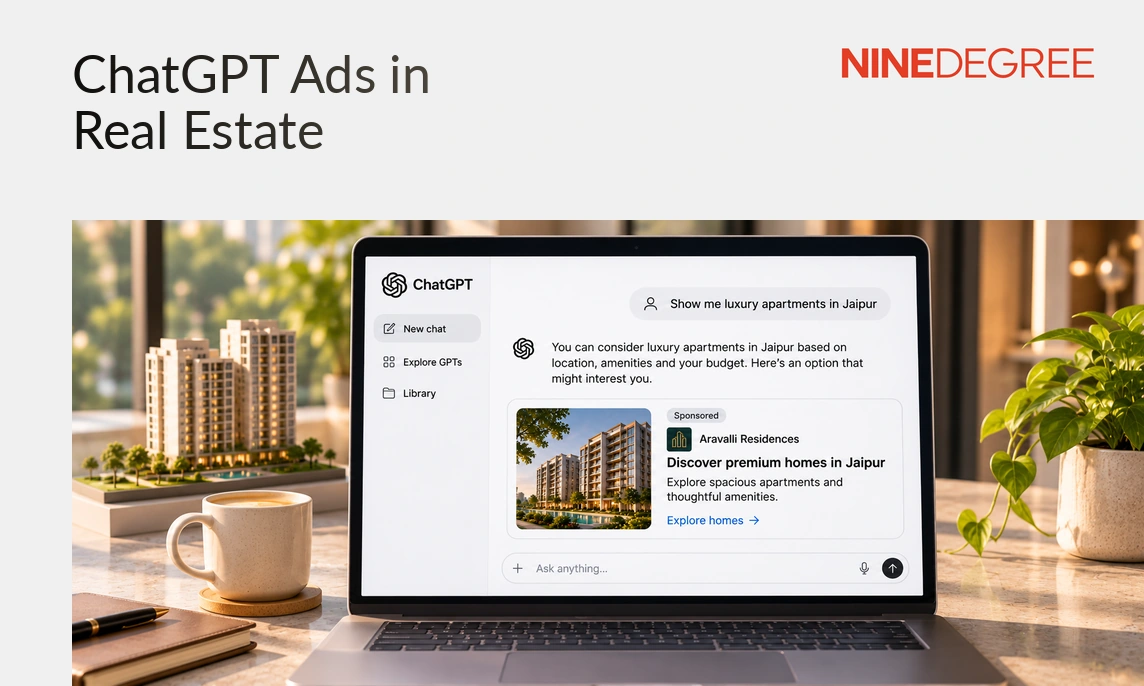
A person looking for a home today begins on Google search, but recently they also will open ChatGPT and search for something specific like:
- Which are the best areas to buy a luxury apartment in Jaipur?
- Is it better to invest in a ready-to-move property or an under-construction project?
- What should I look for before buying a 3 BHK apartment?
These are not simple searches. They are conversations around a decision that could involve several months of research and a substantial financial commitment.
ChatGPT is transforming how individuals search for information, compare options and evaluate enterprises. For real estate brands, this raises a key question: when a potential buyer goes to AI to investigate properties, will your brand be part of the information they discover?
One part of this evolving AI advertising landscape is the adverts for ChatGPT. Another is AI visibility. Knowing both helps developers anticipate a shift in the way in which property buyers search for projects and select brands.
What Are Ads for ChatGPT?
Ads in ChatGPT are sponsored adverts that appear within the framework of the user’s experience. They’re built to present relevant offers inside the framework of a user’s discussion, which makes ChatGPT one of the newest AI advertising platforms available to brands.
For example, if a person is looking into home renovation choices, they might encounter an advertisement for a furniture store or a home improvement store. The ad is different from the response of ChatGPT and is clearly labelled as a sponsored post.
Unlike traditional search advertising, which is mostly based on keywords, ChatGPT Ads takes into account a number of relevant signals. These are the present conversation of the user, the landing page of the ad, its headline and description, context suggestions offered by the advertiser and selected personalisation signals when available.
There is a difference in here now. ChatGPT does not endorse any business simply because an advertisement appears alongside a conversation. The answers from the chatbot are not influenced by paid ads, says OpenAI.
This means ChatGPT is a new AI ads channel, not a paid method to get suggested by AI.
How to Advertise on ChatGPT: Step-by-Step Approach
Businesses in India can now get self-service ChatGPT ads via the OpenAI Ads Manager. However, just because you can access the platform doesn’t mean every business or product category is immediately eligible to advertise.
If your business qualifies, the procedure generally looks like this.
1. Set Up an Ads Manager Account
Go to ads.openai.com and log in using your OpenAI account. You can start by putting in your website URL or setting up an advertiser account first and then creating a campaign.
Fill up the relevant business, billing and account details. The legal organisation that is responsible for advertising and billing needs to be located in a nation where the self-service Ads Manager is offered.
2. Determine Your Campaign Objective
Every campaign should have a defined goal. Currently, there are choices for OpenAI around three basic outcomes:
- Views (CPM): For brand advertisers seeking to drive awareness and increase ad impressions.
- Clicks (CPC): For businesses who want to drive relevant visits to their website.
- Conversions: For campaigns that are optimised for supported actions when a user clicks through.
Your objective drives how you deliver and bill the campaign. Select it based on the outcome you truly desire, rather than considering each campaign as a lead-generation endeavour.
3. Structure Your Ad Groups
Ad groupings are collections of ads that have a common theme, product, service or customer requirement.
For instance, a home improvement company may have separate ad groups for modular kitchens, interior design and home renovation. Each group can have its own messaging and landing page.
This is especially important when a company serves many audiences with varied needs.
4. Include Context Hints
Context cues help OpenAI understand when an advertisement might be appropriate. They aren’t traditional keywords and aren’t commands for exact match targeting.
A vague clue like “home interiors” provides little information. A more relevant one may describe the service, its target consumer and the need it meets.
The purpose is to describe the offer clearly. Context clues help steer relevancy, but they don’t guarantee an ad will pop up in a given conversation.
5. Build Your Ad & Landing Page
Your advertisement needs a good headline, a description, a decent creative and a relevant landing site.
OpenAI suggests avoiding imprecise promotional language and instead using explicit, benefit-orientated advertising. Communicate real, diverse reasons to examine the offering through different creative versions.
Ensure that the landing page provides what the ad claims. Policy compliance is verified for the destination and the creative.
6. Launch, Measure, and Improve
Once your campaign is authorised and ready, you can start it from Ads Manager.
Impressions, clicks, spend, CTR and average CPM / CPC tracking. If you have a conversion measurement set up, you can also check credited conversions.
Use the data to see which messages get people’s attention and which ones drive real action. Adjust your campaign to the real-world performance.
Can Real Estate Developers Advertise on ChatGPT?
This is where real estate brands really need to pay attention.
OpenAI’s existing advertising policy does not allow advertisements for the sale or rental of private homes. But it does enable marketers to connect to websites that have property listings on them, so long as the ad and the landing page don’t mention a particular listing.
This distinction is important. An advertisement for a specific apartment, residential unit or property for sale is not automatically eligible to run just because the advertiser has an Ads Manager account.
And ordinary brand advertising cannot be automatically permitted. OpenAI has eligibility conditions that must be met by the ad, the business being advertised and the landing site.
Real estate businesses should study the latest OpenAI Advertising Policies and request clarification if eligibility is unclear before launching a paid campaign, or work with a partner experienced in AI advertising for real estate and RERA-compliant marketing.
But this doesn’t imply real estate brands should disregard ChatGPT.
There are plenty of ways to get noticed, and paid AI ads are just one of them. The other is to increase your brand’s discoverability when individuals use AI tools to conduct property research, compare locations, and understand the market.
How Real Estate Brands Can Be Discovered on ChatGPT
If someone asks ChatGPT for the greatest residential areas in Jaipur or what to look for before investing in a luxury property, the answer will be based on the knowledge accessible to the system. The web presence of a brand can help with what information is available, but there’s no surefire path to getting cited.
Real estate developers should keep these seven things in mind.
1. Create a Website With Answers to Questions That Actual Buyers Have
A project website has to be more than just pretty visuals and a list of amenities. It should say what a buyer would really want to know.
What configurations do they come in? Where is the project located? How is it to live in the neighbourhood? What kind of amenities are there? What is the difference between carpet area and salable area?
The more explicitly these details are communicated, the easier it is for search engines and artificial intelligence systems to understand the project.
2. Create Location-Specific, Useful Content
If you are a buyer looking for property in Jaipur, you might want to know the difference between Vaishali Nagar, C-Scheme, Bani Park and Jagatpura.
Developers are able to create content that is relevant on locales, infrastructure, connectivity, property prices, lifestyle possibilities and investment concerns.
The trick is to convey meaningful facts and not just keep repeating that a location is premium or well-connected. Specific details make information more beneficial to readers and easier to understand.
3. Answer the Questions Buyers Really Ask
Think of the enquiries your sales team gets every day.
Is a 3 BHK Flat Good for a Growing Family? What should purchasers check before buying an under-construction property? How much open space is required for a residential project? What do you need to check while buying a home?
Turn these queries into well-researched articles, FAQs and pages on your website. This gives your internet presence relevant information beyond the promotional copy.
4. Build a Strong SEO Foundation
Old school SEO still matters. Your website should have clear page titles, descriptive headings, relevant keywords, internal links, fast loading speeds and mobile-compatible pages.
Real estate businesses also benefit from local SEO. Ensure your business details are consistent across key directories and platforms, keep your Google Business Profile up to date and provide accurate location information.
AI discovery is no substitute for SEO. This is why a strong search presence is even more important.
5. Make Project Information Easy to Understand
Don’t hide crucial information in brochures or image-based PDFs.
Provide understandable website content on current configurations, project specs, facilities, location data, construction status and contact information. Clear titles and structured content will assist visitors in locating what they need without having to navigate through many pages.
It’s not quantity. It’s quality. Confusion might occur when the project information is either outdated or not consistent across platforms.
6. Establish a Good Reputation on the Web
Rarely do buyers judge a real estate developer by their website. They will check evaluations, the project’s history, what developments have been completed, any media coverage and customer experiences.
Ask for real client evaluations, post real project updates and keep your company information accurate across all platforms.
A solid digital reputation gives purchasers more reasons to believe what they read about your brand.
7. Maintain Brand Consistency
All of your website, social media, business listings and external publications should present the same basic facts about your firm and projects.
Use the same project names and addresses, requirements and brand descriptions. When information is dispersed or inconsistent, it makes it tougher for humans and search systems to know what’s real.
5 Benefits of AI Visibility for Real Estate Companies
Why would developers take time for this right now? Since property research is no longer confined to one search engine or website.
1. Catch Buyers in the Research Mode
A buyer could spend weeks learning about a place, comparing options and assessing developers before making an inquiry. Rather than waiting for a buyer to be ready to visit a site, you may introduce your brand in this early investigation with useful online content.
2. Build Brand Awareness Beyond Paid Ads
Paid campaigns and AI ads cease delivering when the budget is exhausted. A strong library of useful material can continue to draw visitors via organic search and may also be available to AI-powered discovery tools.
3. Become an Authority in Your Market
A developer who can provide reliable information on local property markets, neighbourhoods and home-buying decisions has more to offer than just promotional claims. It might be a valuable source of info for anyone exploring that market.
4. Respond to Buyer Concerns Before the First Call
Detailed project pages, educational articles and an AI chatbot for real estate can help answer frequent questions before a prospective buyer approaches the sales team. This helps to begin enquiries with a better grasp of the project.
5. Prepare for Changing Search Behaviour
People are turning to conversational technologies more and more to help them navigate complex decisions. These tools will be a more regular part of the research process, and thus now is the time to build a strong digital presence to assist brands in adapting.
ChatGPT vs Google vs Meta Ads: What Real Estate Brands Should Know
These platforms serve different purposes. Treating them as interchangeable can lead to poor campaign decisions.
For most real estate developers, Google and Meta remain important advertising channels. Organic visibility across search engines and AI tools should complement them, not replace them.
The New Era of Real Estate Marketing Has Begun
Real estate marketing has always been about reaching the appropriate buyer at the right time in their decision process. What’s changing is how purchasers obtain information before they ever talk to a salesperson.
ChatGPT Ads are a new form of AI advertising, but the bigger opportunity for property developers is understanding how AI is transforming discovery itself.
The developer with a clear website, useful location-based material, reliable project information and a respectable digital reputation is better equipped to deal with this transformation. Not because the brand is guaranteed to be recommended by the AI, but because it has made its information easier to locate, interpret and assess.
It is no longer only about how many people see an advertisement for a real estate company. It is also about ensuring that the correct information about the brand is available when a prospective buyer begins to ask enquiries. That is why developers increasingly look for a real estate marketing agency that understands both AI ads and organic AI visibility, rather than treating AI advertising companies and SEO as separate decisions.
Frequently Asked Questions
Can real estate developers run ChatGPT ads in India?
Self-service ChatGPT ads are open to businesses in India through OpenAI’s Ads Manager, but eligibility depends on the category. The current policy does not permit ads for the sale or rental of private homes, so an ad or landing page naming a specific listing is not allowed. Developers should read the latest advertising policy and seek clarity from OpenAI before putting budget behind any ChatGPT ads for real estate.
Does advertising on ChatGPT make AI recommend your project?
It does not. OpenAI states that paid ads do not shape ChatGPT’s answers, and sponsored placements are labelled separately from the response. A brand cannot buy a recommendation inside the conversation. What a brand can do is publish clear, accurate and useful information, so that when AI tools draw on the web to answer a property question, your project and developer details are easy to understand and verify.
How can a real estate brand get discovered on ChatGPT without paid ads?
Start with the website. Answer what your sales team hears every day, such as configurations, carpet area versus saleable area, neighbourhood life and construction status, in plain text rather than inside image-based PDFs. Add location pages that compare areas with real details, keep your Google Business Profile current, collect genuine reviews and use identical project names, addresses and descriptions across every platform. Citation can never be guaranteed, but clarity improves your chances.
Should ChatGPT ads replace Google and Meta ads for property marketing?
For most developers, no. Google captures buyers who are already searching for a location or project, and Meta builds awareness, enquiries and retargeting through social content. ChatGPT ads are a developing AI ads channel with housing restrictions, so they suit testing rather than replacing proven spends. Organic visibility across search engines and AI tools works best as a companion to Google and Meta, since it supports them with credibility and discoverability.
What campaign objectives does OpenAI’s Ads Manager offer?
Ads Manager currently offers three outcomes. Views, billed on CPM, suit brands chasing awareness. Clicks, billed on CPC, suit businesses that want relevant visits to their site. Conversions optimise for supported actions after a click. Choose the objective that matches what you actually need, and avoid treating every campaign as a lead-generation exercise, because the objective also determines how delivery and billing work.
Share