One of a buyer's initial in-depth encounters with a project is frequently a property brochure. Customers want something they can look at at their own leisure, share with family, and return to when they're ready to make a choice after viewing an advertisement or talking to a salesperson.
This poses a crucial question for real estate developers. Should paper brochures, digital brochures, or both be the main focus?
How purchasers find, assess, and shortlist properties will determine the response in 2026. While traditional brochures are still useful in in-person interactions, digital brochures facilitate the dissemination of information. Knowing how each format fits within the sales journey is where the true opportunity is found.
1. Describe an Electronic Brochure and Explain How It Differs from a Printed Brochure
An e-brochure is a digital copy of a project brochure that purchasers can view via websites, email, WhatsApp, or other online platforms. It could be available as a specific digital experience, an interactive flipbook, or a PDF.
Printed brochures provide a tangible medium that customers can handle, peruse, and take home. Both convey crucial project details, such as layouts, features, cost, location benefits, and specs.
The way purchasers obtain and utilise such information makes a difference.
Distributing, updating, and sharing digital brochures is simpler. Sales teams don't need to print extra copies when sending an electronic brochure template to several prospects. Additionally, developers don't need to reprint the full brochure in order to update prices, offers, and project specifics.
A physical experience is produced via printed brochures. They are especially useful for site visits, meetings with prospective purchasers, and conversations with several family members.
The purchase context should be taken into consideration while selecting between the two, not only the format. While print can facilitate more in-depth discussions during in-person contacts, digital works well for discovery and follow-ups.
2. Are Printed Brochures at the Site Office Still Desired by Buyers?
Indeed, printed brochures are still useful when selling real estate.
Purchasing a property requires making important financial and emotional choices. Buyers frequently want to go over project specifics, compare setups, and talk about layouts with their family. A tangible brochure provides them with a tangible reference point for these discussions.
The experience at a site office can also be enhanced by printed materials. When purchasers are comparing various configurations or amenities, a well-designed brochure aids sales personnel in providing an organised explanation of the project.
However, printing in bulk before determining demand may result in needless expenses. Inventory might move quickly, project specifications can change, and special offers might only be available for a short time.
Selective use of real estate brochure printing is a more sensible strategy. Save a small quantity of high-quality printed brochures for meetings with channel partners, site visits, and serious prospects. For initial queries, campaign answers, and routine follow-ups, use digital versions.
Additionally, this establishes uniformity throughout the sales process. While sales teams can select the format that works best for each engagement, buyers receive the same essential information both online and offline.
See Real Estate Print Marketing and How Does It Still Drive Site Visits for a more thorough examination of how physical marketing still helps with real estate sales.
3. How Should a Real Estate Brochure Be Made for Mobile and WhatsApp Screens?
On a mobile phone, a brochure that appears impressive on a desktop screen could be challenging to read. Since WhatsApp is used for a lot of property enquiries and follow-ups, mobile usability should be considered from the start.
The objective is straightforward. Purchasers should be able to comprehend the project without having to download an excessively large file, zoom in, or look for specifics.
Here are some guidelines to adhere to.
- Use concise paragraphs, clear headings, and a logical flow of information to make the article easy to scan.
- The project's location, configurations, essential amenities, floor plans, and contact details should all be easily accessible.
- On a mobile screen, buyers should be able to comprehend room layouts, measurements, and setup variations.
- Optimise the size of the file. Large PDFs could take too long to download, particularly for customers with spotty internet.
- Include a pertinent next step, such scheduling a site visit, speaking with a sales representative, or asking for further information. - Make use of unambiguous calls to action.
- The project's positioning should be reflected in typography, colours, photographs, and layouts.
Developers should consider factors other than looks while choosing digital brochure layouts. A helpful template facilitates the sales team's clear communication of the project and supports the way customers consume information.
When teams produce an online e-brochure, the same idea holds true. Design not only for the screen on which the brochure was produced, but also for the device that customers are likely to use.
Teams can learn about various layouts, information formats, and presentation styles by looking at online brochure examples and e-brochure samples. Nonetheless, the audience, pricing range, and sales requirements of the project should be reflected in the final design.
4. Which PDF Brochure Substitutes Are the Best?
Because it is well-known, simple to share, and quick to preserve, a PDF format is still useful. It isn't always the ideal structure, though, for every phase of the purchasing process.
Depending on the experience they wish to create and the quantity of information they need to convey, developers may want to think about additional brochure options.
Digital Microsites
Information about apartments, amenities, floor plans, locations, and inquiry forms is arranged into several parts on a project webpage. While developers can link website analytics and inquiry tracking, buyers can investigate the details that pique their interest.
Microsites are useful for projects that have a variety of setups, a lot of amenities, or precise location data.
Interactive Flipbooks
Turning pages of a real brochure is replicated in a flipbook. It may have clickable links, movies, or navigational elements, and it may feel more interesting than a static PDF.
When developers wish to make a traditional brochure available online while maintaining its visual storytelling, this can be helpful.
Walkthrough Videos
Videos use narration, action, and images to give viewers a better understanding of the project. They may convey a home's ambiance, describe features, and help buyers grasp rooms.
For initiatives that rely on design, lifestyle, or spatial experience to convey their value, video walkthroughs are particularly helpful.
Formats can also be combined by developers. The project can be introduced in a brief WhatsApp message, additional information can be found in a PDF, and consumers can learn more about it through a video or microsite.
See 3D Visualisation and VR Walkthroughs: Why Developers Need Them for Pre-Launch Sales for projects where visualisation is crucial to the decision-making process.
5. How Can You Find Out Who Viewed a Digital Brochure?
Project information can be shared more easily through digital distribution, but mailing a brochure does not guarantee that a buyer has read it.
Reliable information regarding who opened a normal PDF attachment, how much they read, and which pages they visited is typically not available. The way the content is distributed determines how it is tracked.
Developers can increase exposure by using a few useful strategies.
- Instead of depending solely on a direct PDF file, share a link to a hosted brochure or landing page using trackable links.
- Track visits, traffic sources, and interactions on the pages hosting the brochure by connecting website analytics.
- Different links for ads, WhatsApp campaigns, and channel partners can help determine which sources produce engagement.
- When customers submit their information to obtain information or request a callback, sales teams can link the inquiry to the appropriate campaign by integrating inquiry forms with the CRM.
- Monitor any follow-up actions. Keep track of requests for site visits, replies, exchanging of brochures, and further discussions in the CRM.
Not all of these techniques provide the same information. A completed inquiry offers more identifiable information, whereas a link click shows that someone has accessed the link. A click shouldn't be interpreted by developers as evidence of a sincere desire to buy.
When tracking influences the subsequent sales action, it becomes more valuable. While a customer who schedules a site visit might require location details and an appointment confirmation, a buyer who seeks a floor plan might require configuration specifics.
Instead of sending repeated communications without context, the goal is to assist sales teams in following up with pertinent information.
See Real Estate WhatsApp Promotion Messages: 20 Ready Templates for Launches, Site Visits and Follow-Ups for additional useful suggestions.
So, in 2026, Which Is More Effective for Real Estate Sales?
Printed and digital brochures have various uses. Convenience, increased dissemination, and tracking possibilities are all provided by digital brochures. Printed brochures facilitate in-person conversations and provide customers with a concrete point of reference.
For the majority of real estate developers, using both forms with a specific goal is a preferable strategy.
For queries, campaign responses, and follow-ups, use a digital brochure that is optimised for mobile devices. For site visits, sales meetings, and purchasers who prefer tangible materials, keep printed versions on hand. Support the brochure with a microsite, flipbook, or video walkthrough if the project requires a more comprehensive experience.
The quality of the information is more important than the format choice. A brochure should assist purchasers in comprehending the project, weighing their options, and confidently moving forward.
At Nine Degree, we view the brochure as a component of a broader communication process. The degree to which a buyer is moved from initial interest to a meaningful sales conversation depends on how well the design, content, and distribution work together.
Frequently Asked Questions
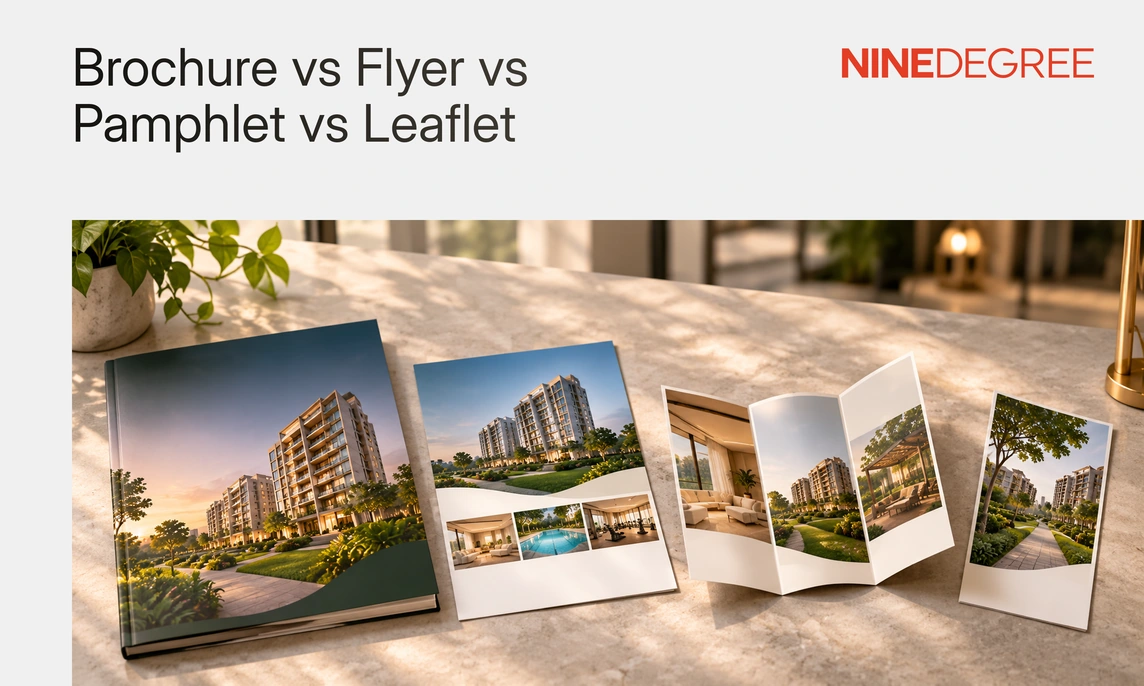
1. What is the difference between a brochure, a flyer, a pamphlet and a leaflet?
A brochure provides detailed project information, a flyer promotes a specific offer or announcement, a pamphlet shares key information in a compact format, and a leaflet communicates essential details on a single sheet.
2. Which one should a real estate project use for a launch, a site visit or a newspaper insert?
Use flyers or leaflets for launch announcements and newspaper inserts. Printed brochures work well for site visits and sales meetings, while digital brochures are ideal for enquiries and follow-ups.
3. What should a real estate pamphlet include?
Include the project name, location highlights, configurations, key amenities, relevant visuals, contact details and a clear call to action, such as booking a site visit.
4. Is a flyer or a brochure better for property expos and channel partner meets?
A brochure works better for detailed project presentations, while a flyer helps communicate key highlights or offers quickly. Using both can support different stages of the sales conversation.
5. How many pages or panels does each format usually have?
A brochure typically has multiple pages, while a flyer or leaflet usually uses a single sheet. A pamphlet may have a few pages or folded panels. The format depends on the information you need to communicate.
Share