


| Format | What it does | Best used for |
|---|---|---|
| Static 3D renders | Fixed images of exteriors, interiors, amenities | Ads, brochures, portals, hoardings |
| 3D walkthroughs | Self-guided video or interactive tour | Landing pages, WhatsApp follow-up |
| VR walkthroughs | Headset-based immersive experience | Sales gallery, NRI buyers, premium projects |
| AR experiences | Overlaying design onto a real space | Site visits, furniture and finish options |
Start with renders and a walkthrough. Add VR only if your sales gallery or buyer profile justifies it.
Introduction
Selling an unbuilt flat is a strange job. You're asking someone to commit a large part of their savings to a space they cannot stand in, based on a two-dimensional floor plan most buyers can't read properly.
For years the answer was a sample flat and a scale model in the sales office. Those still work - but they only work on people who physically arrive. And today, most buyers have already shortlisted two or three projects before they visit anything.
That's the case for 3D visualization. Not because it's modern, but because it moves the emotional part of the decision earlier, to the point where the shortlist is actually being formed.
This guide covers what 3D visualization actually includes, why it matters most in pre-launch, which formats are worth the effort, and the mistakes that make developers spend on renders that never sell anything.
What Is 3D Visualization in Real Estate Marketing?
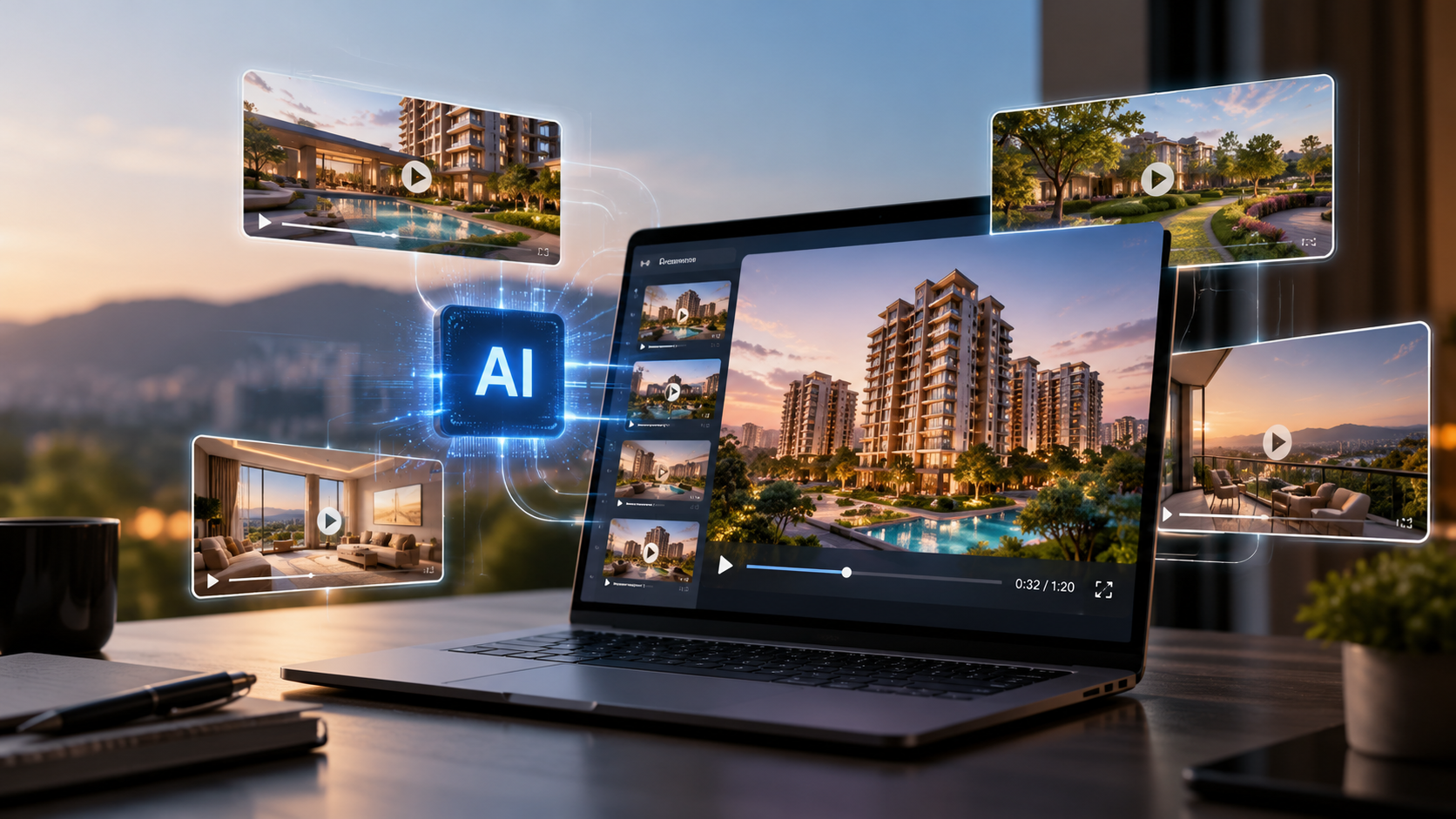
3D visualization in real estate is the process of creating photorealistic digital images and environments of a property from architectural drawings, before construction is complete. It covers still renders, animated walkthroughs, interactive tours and VR experiences - all built from the same underlying 3D model.
The workflow is straightforward: architectural plans are converted into a 3D model, materials and lighting are applied, and then that model is output in whatever format the marketing needs. One model can produce hoarding artwork, brochure images, a website walkthrough and a VR experience.
That last point matters commercially. Developers often commission renders and a walkthrough as separate jobs from separate vendors, then discover the two don't match. Building one model and outputting multiple formats from it is considerably more efficient, and keeps everything visually consistent across your marketing. It's also why a real estate marketing agency running the wider campaign is usually the right place to brief this from - the visualization needs to be specified against where the assets will actually be used, not commissioned in isolation and fitted in afterwards.
Worth being clear about what this is not: 3D visualization is not a 360° photo tour. Those require a built space. Visualization is what you use when there is nothing to photograph.
Why Pre-Launch Projects Need VR Walkthroughs and 3D Renders
Pre-launch projects need 3D visualization because during pre-launch you have no physical product. Every other phase of a project has something real to show. Pre-launch has drawings, a location and a promise - and visualization is what converts that into something a buyer can respond to emotionally. Pair the walkthrough with the right offer timing - the psychology behind early bird pricing and pre-launch success explains why the first few weeks decide the campaign.
The market context makes this sharper. Anarock's 2026 data showed new launches overtaking sales across the top seven cities, which means buyers in most micro-markets now have genuine choice. When a buyer is comparing three under-construction projects at similar price points, the one they can see has an advantage the others don't.
There's also a timing argument. Buyer research now happens almost entirely before contact - a shift covered in more detail in Real Estate Lead Generation Strategies for Developers in 2026. If your project is being evaluated in a browser tab at 11pm alongside two competitors, a floor plan PDF is losing that comparison.
And for a meaningful segment of Indian residential demand - NRI buyers - visualization isn't a preference. It's the only way they will ever see the property before booking.
Key Benefits of 3D Visualization for Developers
Helping Buyers Visualize Before Construction Is Complete
Most buyers cannot read a floor plan. They can identify the rooms, but they cannot translate dimensions into a felt sense of space - whether the living room fits their sofa, whether the kitchen is workable, what the balcony actually looks out onto.
3D visualization removes that translation step. Instead of interpreting a drawing, the buyer sees the room. NAR's research found 41% of buyers rate 3D tours as very useful in their search - and that's for existing homes, where photographs are also available. For unbuilt property, where there is no alternative, the value is higher.
The specific things worth visualizing: actual view from typical floors (not an idealised skyline), natural light at different times of day, and at least two unit configurations rather than only the largest.
Reducing Buyer Hesitation & Speeding Up Decisions
Off-plan hesitation is mostly a fear of the unknown. The buyer isn't unsure whether they want a home - they're unsure whether this home will match what they've been shown. Visualization narrows that gap by making the promise specific.
It also gives your sales team something to send. A walkthrough link over WhatsApp after the first conversation keeps the project present during the two or three weeks a buyer typically spends deciding. A brochure PDF does not get reopened. A walkthrough often does.
A caution here: shortened decision times are the most commonly claimed benefit and the least reliably measured. Most published figures come from rendering studios marketing their own services, with no methodology attached. Treat any vendor quoting a specific percentage uplift with scepticism, and measure your own before-and-after instead.
Standing Out in a Competitive Micro-Market
In a locality with six similar projects, differentiation is difficult. Layouts are comparable, price bands overlap, amenities lists read identically. Presentation becomes the variable.
Good visualization signals seriousness. Rightly or wrongly, buyers read production quality as a proxy for construction quality - a project with careful, honest renders reads as a developer who pays attention. Poor renders do the opposite, which is why bad visualization is worse than none.
Types of 3D Visualization Tools Used in Real Estate
Static 3D Renders
Fixed high-resolution images of exteriors, interiors, amenities and site layouts. These remain the workhorse of Indian real estate marketing - they carry hoardings, brochures, portal listings, print and social ads.
Best for: broad reach and top-of-funnel work. Every project needs these. Prioritise an exterior day shot, an exterior evening shot, two interior views per configuration, and the amenity deck.
Virtual Reality (VR) Walkthroughs
Headset-based experiences where a buyer moves through the space at real scale. VR is the most persuasive format and the most limited by access - it needs hardware and, usually, someone present to run it.
Best for: sales galleries and experience centres, premium and luxury projects, and NRI buyers visiting India briefly. Not worth it if your primary channel is a website, because most visitors won't have a headset.
Augmented Reality (AR) Experiences
AR overlays digital content onto the real world through a phone camera - pointing at an empty plot to see the tower, or switching finishes and furniture inside a sample flat.
Best for: on-site use during visits, and for finish or furnishing options. Still the least adopted of the three in Indian residential, which makes it a genuine differentiator where it fits.
Which to choose: renders for reach, walkthroughs for conversion, VR for the sales gallery, AR for site visits. Most projects should start with renders plus one interactive walkthrough, then add formats based on what the sales team says buyers keep asking to see. A real estate marketing agency working across the campaign can help sequence this so the assets are ready when each phase actually needs them.
How 3D Visualization Improves Site Visit & Booking Conversion
Visualization improves conversion by doing two things: it increases the number of enquiries that turn into site visits, and it makes the site visit itself more productive because the buyer arrives already familiar with the project. That is the service in one line - see our 3D visualization services for renders, walkthroughs, VR tours and floor plans.
Where it works in the funnel:
- Enquiry to site visit: Sending a walkthrough link within the first WhatsApp exchange gives the buyer a reason to engage before committing to a Sunday. It also filters - someone who watches the full walkthrough and still wants to visit is a qualified visitor.
- During the visit: VR in the sales gallery lets a buyer experience the specific floor and configuration they're considering, not just the sample flat.
- After the visit: The walkthrough is what gets forwarded to the spouse, parents or a relative abroad. In Indian home buying, decisions are rarely made by one person, and visualization travels to the people who weren't at the site.
- NRI and outstation buyers: Here visualization does the entire job of the site visit.
One measurement note: track site visits from leads who opened the walkthrough versus those who didn't. It's a simple comparison, it takes no extra tooling, and it will tell you more about whether visualization is working for your project than any industry statistic.
Common Mistakes Developers Make with 3D Visualization
Overselling the reality: Renders that show a park that will be a parking lot, or a view that will face another tower, create booking-stage disputes and RERA exposure. Accurate visualization is a legal position, not just an ethical one - under RERA, promotional material forms part of what a buyer relied on, and a render that materially misrepresents the delivered product is actionable. Worth reading alongside this: RERA-Compliant Marketing: What Every Real Estate Developer Should Know, which covers what can and cannot be shown in pre-launch advertising, and at what stage.
Only rendering the largest configuration: Buyers of the 2 BHK see the 4 BHK renders and don't know what they're getting. Render every configuration you're selling.
Commissioning renders with no distribution plan: Beautiful images sitting in a folder are the most common waste in this category. Decide before commissioning where each asset goes - hoarding, landing page, WhatsApp, portal, brochure.
Treating it as a one-time purchase: As the project progresses and inventory changes, you need assets for what's actually left. The clearance phase often needs different visuals than launch.
Choosing on price alone: Weak renders actively damage perception. If the output looks like a video game, buyers notice.
Building assets after the campaign starts: Visualization takes weeks. Commission during design finalisation, not after the launch date is set. This sequencing failure is common enough that it's worth checking whether your partner plans for it.
Conclusion
For pre-launch, 3D visualization isn't marketing decoration. It's the product demonstration - the only one available until the building exists.
The practical order is simple. Get accurate renders of every configuration you're selling. Add one interactive walkthrough that your sales team can send over WhatsApp. Consider VR only if you have a sales gallery or a buyer profile that justifies it. Then measure whether leads who viewed the walkthrough convert to site visits at a better rate than those who didn't.
Accuracy matters more than ambition. A modest, honest set of renders that match what gets built will serve you better through possession than spectacular images you have to explain away at handover.
If you're planning pre-launch assets for an upcoming project and want them sequenced against your campaign phases, Ninedegree works with developers on exactly that.
Frequently Asked Questions
What is the difference between 3D visualization and VR walkthroughs?
3D visualization is the broad category - creating digital images and environments of a property from architectural plans. VR walkthroughs are one output of that process, delivered through a headset so the buyer moves through the space at real scale. Static renders and video walkthroughs are also 3D visualization, but they're viewed on a normal screen. All formats come from the same underlying 3D model, which is why building one model and outputting several formats is more efficient than commissioning them separately.
How much does 3D visualization cost for a real estate project?
Cost varies too widely for a useful benchmark, because it depends on scope rather than project size. The main drivers are: number of unit configurations rendered, interior versus exterior only, static images versus interactive walkthrough versus VR, level of photorealism, number of revision rounds, and turnaround time. Rush delivery raises cost significantly. Get quotes against a defined asset list - for example, six exterior renders, two interiors per configuration, one walkthrough - rather than asking for a general project figure, which makes proposals impossible to compare.
Can 3D visualization replace physical site visits?
Not for most Indian buyers. Visualization increases site visits rather than replacing them - buyers still want to assess location, traffic, neighbourhood and construction quality in person. The exception is NRI and outstation buyers, for whom a walkthrough often does substitute for the visit entirely. Treat visualization as what gets a buyer to the site already convinced about the product, so the visit can focus on location and trust rather than explaining layouts.
Which stage of a project benefits most from VR walkthroughs?
Pre-launch and launch benefit most, because that's when there is no physical product and the highest number of undecided buyers. VR specifically works best in a sales gallery during launch, where a buyer can experience their exact floor and configuration rather than the generic sample flat. During clearance, VR is less useful than updated renders and walkthroughs of the specific unsold units, since those buyers need to see what's actually still available.
Do VR walkthroughs actually increase real estate bookings?
Evidence suggests they help, but be careful with the numbers you'll encounter. NAR research found 41% of buyers consider 3D tours very useful, and the mechanism is well understood - buyers who can picture a space commit more readily. However, most dramatic ROI figures circulating online come from rendering studios promoting their own services, with no stated methodology. Measure it yourself: compare site-visit rates between leads who opened your walkthrough and those who didn't.
Share



.png)


.png)