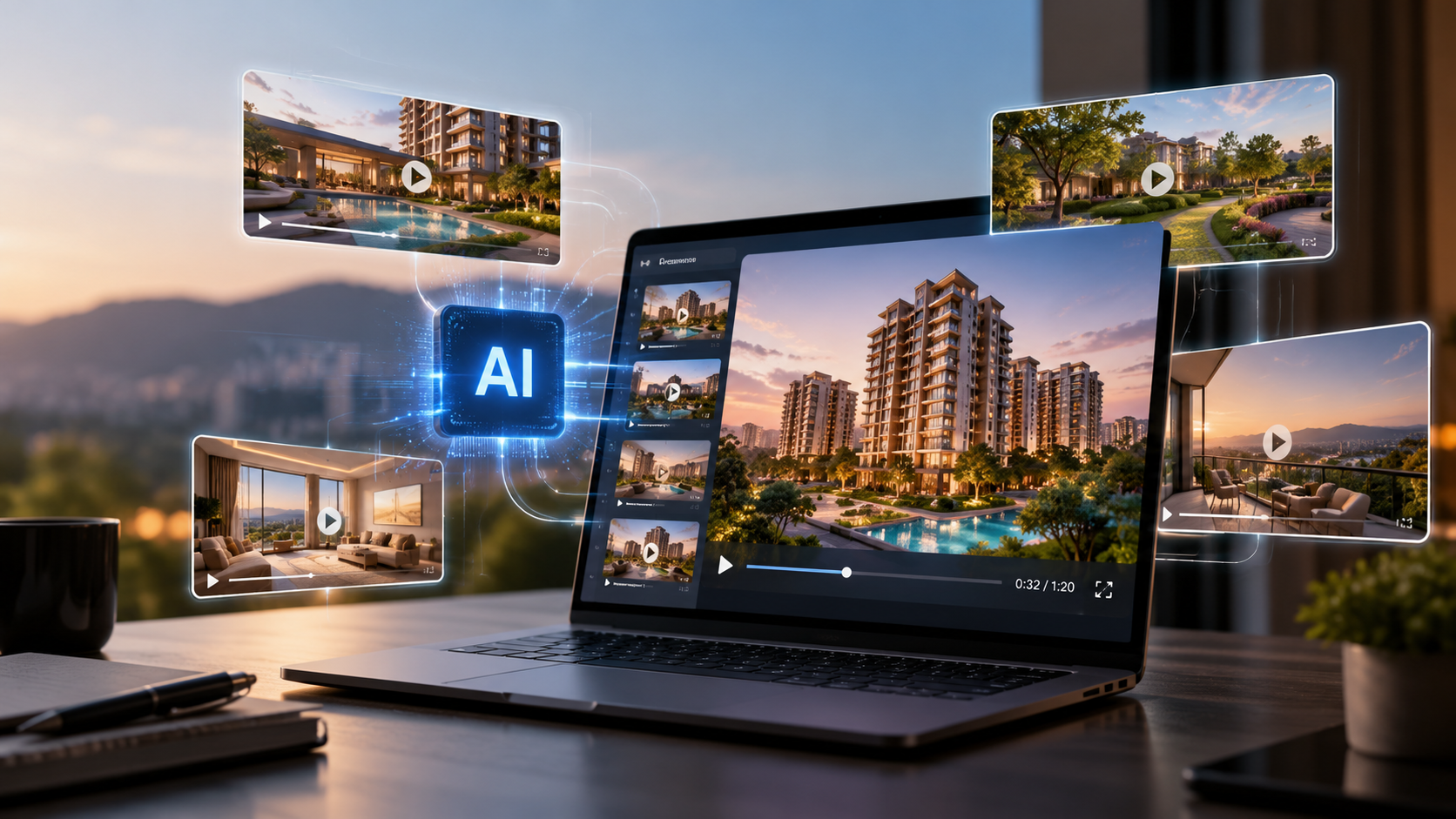
AI-generated video sits between the two. Used with care, it helps creative teams add movement, atmosphere and story to what a developer already has: approved renders, a project brief and a clear audience. Used carelessly, it can mislead buyers and weaken trust.
This guide covers where AI video helps real estate campaigns, where it falls short, and how to use it responsibly. If you're looking forAI still images and campaign characters, we've covered that in How Generative AI Is Transforming Real Estate Marketing in 2026. This article is about video.
What "AI-Generated Video" Actually Means in Real Estate
The term covers several different things, and mixing them up leads to bad briefs:
Image-to-video: animating an approved render with a slow camera move, drifting clouds, moving water or evening light.
Text-to-video: generating short clips from a written description, such as an atmospheric scene of a family on a balcony at dusk.
AI-assisted editing: resizing, captioning, cutting and re-timing footage that was shot or rendered conventionally.
Synthetic voice and language versions: narration or dubbing in multiple languages.
Each has a different risk profile. Animating an approved render is relatively safe. Generating a "building" from a prompt is not, because it can invent features the project doesn’t have.
Why Video Suits the Way Buyers Browse
Buyers rarely begin at the sales gallery. They start on Instagram, YouTube or Google, as we explain in our post on why creative ad films are replacing traditional real estate campaigns. Moving visuals earn attention in a feed where a static render may get a glance.
AI helps by lowering the cost of trying a creative idea. A team can test several visual directions before committing to a full production, so engagement comes from the idea rather than from volume.
Where AI Video Fits in a Real Estate Campaign
Conceptfilms and storyboards
Before a shoot, AI clips can turn a script into a rough visual, so developers see the mood, pacing and setting early. This catches misaligned expectations before production budgets are spent.
Bringing approved renders to life
A static exterior can become a short sequence: light shifting from afternoon to dusk, subtle camera movement, foliage in the breeze. The architecture stays as approved while the atmosphere adds feeling.
Pre-launch teasers
For a project still awaiting launch, short teasers can build curiosity around the location, the idea or the lifestyle. Registration rules still apply (see Section 8).
Lifestyle and mood sequences
Instead of generic stock footage, a team can build scenes that suit the project's climate, architecture and audience: a morning walk through a landscaped podium, children in a play area, a festival evening in a courtyard.
Multi-format and multi-language versions
One core film can be reshaped into vertical reels, square feed posts, short ad cut-downs and festive variants. Voiceovers can be adapted to regional languages, which matters for a market like Rajasthan, where buyer audiences and NRI families may respond to different languages.
Campaign characters in motion
If a campaign already uses a consistent character, AI can help extend that character across video formats. Our FLIP campaign for Nature Tulsi, described in the generative AI post linked above, is an example of a recognisable face adapted across formats.
Illustrative Scenarios
These are examples of how a team could use AI video. They are not client case studies.
Residential apartment launch. A 60-second brand film is shot conventionally with a family. AI-assisted editing produces 15-second reels, a vertical teaser for Instagram, and a Hindi-language version for regional audiences, all from one master story.
Plotted township. A static master plan is hard for buyers to read. An approved aerial render is animated into a gentle fly-through that shows the entry gate, internal roads and green areas, with a clear "artistic impression" label.
Premium villa project. A short mood film built around morning light, materials and quiet spaces supports a luxury positioning. Details such as finishes and floor plans are shown through verified assets, not generated footage.
Festive campaign. A base film gets Diwali, Akshaya Tritiya or Independence Day versions without a fresh shoot each time, as long as the offer details come from approved documents.
Benefits of AI-Generated Video
Faster ideation. Directions can be tested before full production.
More variations from fewer assets. One approved asset base can serve several platforms.
Visualisation of unbuilt projects. Buyers get a feel for space, light and surroundings earlier.
Language flexibility. Versions for different audiences are quicker to produce.
A lower barrier for smaller campaigns. Projects that can't fund a full film every time can still have moving content.
These are workflow benefits, not guaranteed sales outcomes. Results depend on the idea, the audience and the media plan, so measure them for your own project.
Limitations to Plan For
Our view is that AI video should support a campaign, not carry it. Common limitations include:
Accuracy drift. Generated frames can add floors, alter balconies, change materials or invent amenities. For a regulated product like housing, that is a serious risk.
Short clips and consistency gaps. Tools commonly produce brief clips, and faces, objects or lighting can change between shots. Longer films need careful editing.
Artificial look. Overly smooth or "too perfect" footage can feel unreal and reduce credibility, especially for premium audiences.
Unreliable details. Text, signage, hands, crowd movement and physical behaviour (water, fabric) can look wrong.
Rights and terms. Tools differ on commercial use and likeness. Check the licence terms before using output in paid advertising.
Not a substitute for real footage. Once a project is built, real site footage, sample flats and resident stories carry credibility that synthetic footage cannot.
Best Practices
1. Start with the buyer, not the tool. Define who the video is for, what they need to feel or understand, and where they'll see it.
2. Build from approved assets. Use sanctioned renders, plans and verified project details as the base.
3. Write the story first. A short script and storyboard keep clips connected instead of looking like a showreel.
4. Keep humans in charge. A creative director and editor should shape pacing, music, voice and colour. A good prompt is not a campaign.
5. Check every frame. Compare against approved drawings before anything goes live.
6. Mix AI with real footage. Use real drone, site and sample-flat footage where it exists. Use AI for atmosphere and adaptation.
7. Don't fake people or proof. Avoid synthetic "residents" giving testimonials or invented crowds at a site.
8. Version carefully. When a date, price or offer changes, every language and format version needs to change with it.
9. Test and measure. Track view-through, enquiries and site-visit bookings for each version, and keep what works.
Compliance and Disclosure: Don't Skip This
RERA still applies. Under RERA, a video is an advertisement like any other. Our RERA compliant marketing guide explains that a project must be registered before it is marketed, that the registration number and authority website must appear prominently in advertisements, and that visuals which are not photographs of the built asset must be declared as artistic impressions. Treat AI-generated footage the same way.
India's AI-content rules. On 10 February 2026, MeitY notified amendments to the IT Rules that bring synthetically generated information, including deepfakes and otherAI generated content, within the rules' due diligence framework, effective 20 February 2026. The notification says such content should be prominently labelled so it can be immediately identified as synthetic. The obligations fall mainly on platforms, but advertisers should expect to declare AI-generated video when publishing and to label it clearly. Confirm specifics with your legal counsel.
Platform disclosure. YouTube requires creators to disclose content that is meaningfully altered or synthetically generated when it seems realistic, while unrealistic content and minor edits generally don't need disclosure. Check each platform's current policy before you publish.
A simple rule: if a buyer could mistake the footage for the real, finished project, label it.
A Practical Workflow for Developers
1. Brief: audience, positioning, platform and the single message.
2. Asset audit: gather approved renders, plans, photos and verified facts.
3. Script and storyboard: decide what is real footage, what is rendered and what is AI assisted.
4. Generate and animate: produce clips from the approved base.
5. Edit with human direction: pacing, sound, colour, voiceover.
6. Accuracy and compliance check: compare against drawings, add the RERA details and artistic-impression label, applyAI disclosure.
7. Publish and test: release versions by platform and language.
8. Review and refine: keep the formats that bring enquiries and site visits.
Where AI Video Doesn't Belong
Showing finished interiors, finishes or views that don't match the approved project Fabricated testimonials, residents or "sold out" crowds
Claims about connectivity, possession or approvals that aren't backed by documents Anything that replaces a real site visit when the project is ready to be seen
Final Thoughts
AI-generated video is best treated as a creative tool, not a shortcut. It can add movement, mood and flexibility to a real estate campaign, but its value depends on a strong idea, accurate source material and honest labelling. The campaigns that benefit will be the ones that stay true to the project while using the technology to help buyers imagine it.
At Nine Degree, we combine real estate marketing strategy, 3D visualisation, video and ad films, and storytelling to build campaigns that are distinctive, credible and commercially focused. To see how this fits into a wider programme, read about AI for real estate marketing.
Frequently Asked Questions
What are AI-generated videos in real estate marketing?
They are videos created or assisted byAI tools, such as animating approved renders, generating short atmospheric clips, editing footage into multiple formats, or producing multilingual voiceovers.
Can AI-generated videos replace traditional real estate videography?
Not fully. AI can support concept films, teasers and format versions, but real footage of the built project and sample flats is more credible for final decisions. Our real estate videography guide covers conventional video.
Are AI-generated property videos allowed under RERA?
RERA applies to advertisements in any medium. The registration number and authority website must appear prominently, claims must be accurate, and non-photographic visuals should be declared as artistic impressions. Confirm state-specific rules with your legal team.
Do I need to label AI-generated real estate videos?
You should, particularly if the footage looks realistic. India's 2026 IT Rules amendment requires prominent labelling of synthetic content on in-scope platforms, and YouTube asks creators to disclose realistic synthetic content.
What are the risks of using AI video for a property launch?
The main risks are inaccurate depictions of the building, inconsistent visuals, rights and licensing issues, and loss of trust if buyers feel misled.
Which real estate projects benefit most from AI video?
Pre-launch residential projects, plotted townships and campaigns that need many format or language versions benefit most, because buyers can't yet see the finished project.
How should developers measure the results?
Track view-through rates, enquiry volume and quality, and site-visit bookings for each video version, rather than relying on views alone.
Share