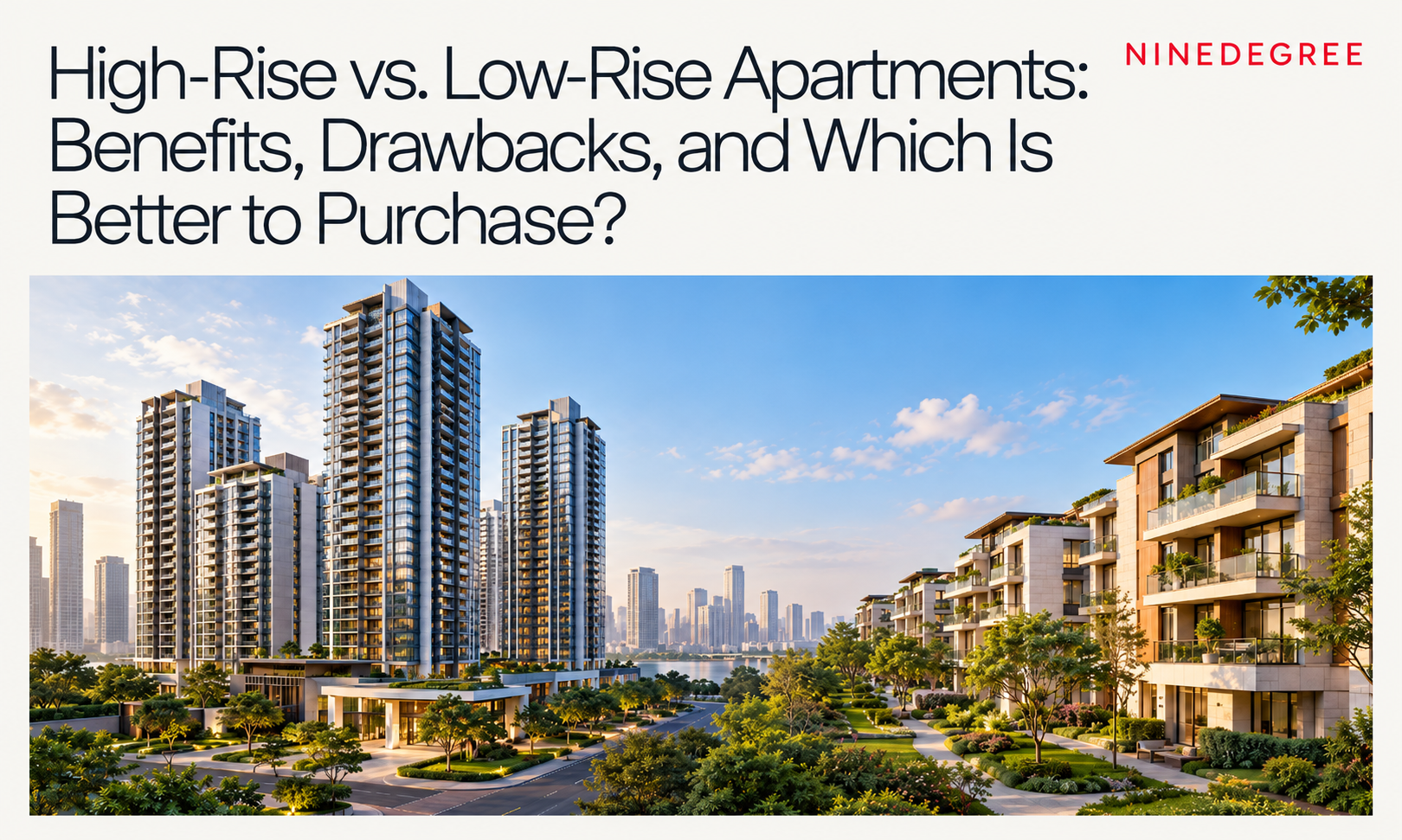
The location, cost, carpet space, and amenities are typically the first factors that people compare while looking for an apartment. However, there is another choice that might subtly affect daily life for years. Which would you prefer: a low-rise apartment complex or a house in a high-rise tower?
There is more to the distinction than just the number of floors. It has an impact on how you walk through the building, how much privacy you enjoy, how you perceive your surroundings, how much you pay for maintenance, and even how the property performs when you decide to sell it.
In India's metropolitan housing markets, high-rise flats are becoming more prevalent, especially in areas with limited land and rising demand for organised residential communities. Conversely, customers who want a more grounded lifestyle, fewer neighbours, and easier access to their homes are drawn to low-rise apartments.
Neither choice is inherently a superior home or investment. The ideal option will rely on your expectations for the house, location, lifestyle, and financial situation. You may make a choice that will benefit you long after you have your keys if you are aware of the differences.
1. What Distinguishes Low-Rise Apartments from High-Rise Apartments?
The building's height is the most visible distinction, but there are many other factors that affect how each type of property feels to live in.
High-rise apartments are multi-story residential structures that are usually supported by centralised building management, structured fire safety systems, elevators, and common areas. They are frequently a part of larger residential complexes that include fitness centres, clubhouses, landscaped areas, security systems, and designated parking.
Low-rise apartments often have a smaller residential area and fewer storeys. Depending on the development, they might have elevators, stair access, few shared amenities, and a comparatively smaller resident base.
Buyers should investigate the relevant regulations rather than relying on a general floor-count definition because building classification might also vary depending on local development regulations and fire safety requirements.
The building's layout and integration with the neighbourhood are the more significant differences.
Open areas, seclusion, natural light, and a variety of amenities can all be found in a well-designed high-rise building. Despite its height, a badly designed one may feel cluttered. Similar to this, a low-rise apartment complex can offer a cozy living space, but fewer stories by themselves do not ensure improved privacy, ventilation, or construction quality.
Buyers should be more concerned with which building provides a better quality of life for the money than with which one looks more stunning.
2. The Reasons Behind India's Growing Interest in High-Rise Apartments
As Indian cities grow, urban housing has seen significant change. Infrastructure corridors are generating new residential hubs, land values have gone up in established areas, and purchasers are seeking homes that combine lifestyle amenities, security, and convenience.
Many of these expectations are met by high-rise residences.
Developers may build more homes on a given piece of land while still making room for roads, parking, landscaping, and shared amenities by constructing vertically. This becomes especially important in expanding metropolitan areas where linked land is expensive.
The allure for purchasers frequently goes beyond the flat itself. Within a single residential community, a high-rise development might include a clubhouse, gym, kid-friendly play areas, walkways, security systems, and controlled common areas.
The opinions may also play a role. Higher-level residences may have better daylight and ventilation as well as more open views, depending on the orientation and nearby structures.
The site, tower spacing, floor plan, and nearby development all affect these advantages, though. Better air does not always follow from a higher floor, and a long list of facilities does not always equate to better daily living.
High-rise apartments are becoming more and more popular in India, which is indicative of a larger change in consumer expectations. Instead of viewing homes as discrete units within a building, people are increasingly evaluating homes as entire living settings.
3. The Benefits of Purchasing a High-Rise Apartment
The ability to combine private living with shared lifestyle amenities is a high-rise apartment's greatest benefit.
Residents in a well-planned development can access community zones, fitness centers, landscaped areas, and recreational areas without leaving the property. Having these facilities close by can make daily routines easier for older residents, working professionals, and families with kids.
Higher floors may also provide more privacy from nearby properties, wider views, and a better distance from street-level noise. The location, building quality, window design, and surrounding structures all affect the true benefit.
Another factor is security. Numerous high-rise buildings have managed visitor access, CCTV coverage, security guards, and controlled entry points. Although the quality of security ultimately depends on how well the systems are maintained, these features can contribute to the creation of a more organized residential environment.
Additionally, there is a community component. Through common areas and activities, larger developments can unite residents with similar lifestyle choices and foster social interaction.
For buyers who value convenience, amenities and a managed residential setting, these advantages can make high-rise apartments an attractive option.
The important thing is to evaluate the facilities that residents will actually use. A development with fewer but well-maintained amenities may offer more value than one with an impressive list of facilities that receive little attention after possession.
4. The Disadvantages of High-Rise Living
High-rise living introduces a different set of practical considerations, and buyers should understand these before making a purchase.
The first is dependence on lifts. In a multi-storey building, lifts become an essential part of everyday movement. During maintenance, power interruptions or unusually busy periods, residents may experience delays. Buyers should check the number of lifts serving each tower, their capacity, backup arrangements and maintenance standards.
The second consideration is the cost of managing a larger building. Lifts, fire safety equipment, common-area lighting, pumps, generators, security systems and shared amenities require regular maintenance. These expenses contribute to monthly maintenance charges, although the actual amount depends on the development and how costs are allocated among residents.
High-rise buildings also require careful attention to fire safety, emergency evacuation and structural quality. Buyers should examine the applicable approvals, safety provisions and maintenance arrangements rather than assuming that a modern building automatically meets every expectation.
Privacy can vary as well. Apartments facing other towers may have limited visual privacy, even on higher floors. Dense development around a property can also affect daylight, views and ventilation over time.
Finally, the experience of reaching home may involve longer waiting times, multiple lift stops and a greater distance between the apartment entrance and the building exit.
These factors do not make high-rise apartments a poor choice. They simply make building management, planning and long-term maintenance important parts of the buying decision.
5. What Makes Low-Rise Apartments Attractive?
Low-rise apartments appeal to buyers who prefer a smaller residential environment with fewer floors and, often, fewer neighbours sharing common spaces.
One of the most noticeable benefits is accessibility. Depending on the building design, residents may be able to reach their homes without relying heavily on lifts. This can be useful for families with young children, older residents and people who prefer simpler access.
Smaller buildings can also create a more familiar community atmosphere. With fewer apartments, residents may find it easier to interact with neighbours and coordinate everyday matters.
In some developments, low-rise buildings offer a stronger connection to gardens, streets and outdoor areas. This depends on the site layout, apartment orientation and the amount of open space available around the building.
Maintenance arrangements may be simpler in a smaller building, especially when there are fewer shared systems and amenities. However, buyers should not assume that maintenance charges will always be lower. A building with fewer apartments has fewer households among which to distribute common expenses, which can increase each resident's share.
Low-rise apartments can also be attractive in established neighbourhoods where residents value proximity to local markets, schools, parks and everyday services.
The appeal comes from the overall residential setting, not simply from the building's height.
6. High-Rise vs Low-Rise Apartments Across Everyday Priorities
The most practical way to compare the two options is to consider how each one affects the things that matter to you.
- Space and amenities
High-rise developments often have more scope to accommodate clubhouses, gyms, swimming pools, landscaped areas and other shared facilities. Low-rise projects may offer fewer amenities, although some premium low-rise developments provide extensive facilities as well.
- Privacy and noise
Higher floors can offer greater separation from street activity, but privacy also depends on tower spacing, window placement and nearby buildings. Low-rise apartments may feel more connected to their surroundings, which can mean more exposure to neighbourhood noise.
- Accessibility
Low-rise buildings can offer simpler access to individual homes. High-rise apartments rely more heavily on lifts, making lift availability, capacity and backup systems important considerations.
- Maintenance
High-rise buildings usually have more complex shared infrastructure. Low-rise buildings may have simpler common systems, but their maintenance costs depend on the facilities provided, building condition and number of households sharing the expenses.
- Views and natural light
Higher floors may provide more open views and less obstruction from nearby buildings. However, the apartment's direction, window placement, tower orientation and surrounding development remain important.
- Community living
Large high-rise developments can support a wider range of community facilities and organised activities. Smaller low-rise buildings may provide a more intimate residential environment.
- Investment potential
Both property types can do well when the location, construction quality, pricing and buyer demand support their worth. Building height alone does not determine appreciation or resale potential.
The comparison becomes more relevant when purchasers analyze these aspects against their own habits instead of seeing one group as uniformly preferable.
7. Which Floor Is Best to Buy in a High-Rise Building?
Floor selection is one of the most typical questions buyers ask when comparing high-rise apartments. Some prefer lower floors because they allow quicker access. Others favor higher floors for their views, seclusion and separation from street-level activities.
There is no particular floor that works best for every dwelling.
Lower floors may be helpful for people who desire quicker access to the entrance, landscaped areas or outside facilities. Their suitability also depends on the building's ground-level layout, parking arrangements and the amount of noise or activity near the tower.
Middle floors often create a sensible balance between accessibility and elevation. They may offer useful views without elevating occupants too much above the ground, although the exact experience depends on the construction.
Higher floors can afford more open views, more distance from certain street-level disturbances and a better sense of seclusion. However, they may also imply longer lift travels and higher dependence on the building's vertical mobility systems.
Before picking a floor, purchasers should consider the following:
- View and orientation: Check whether the apartment faces open space, another tower, a road or a prospective development site.
- Natural light: Examine daylight at different times of the day rather than depending completely on the sample flat.
- Ventilation: Look at window positioning, cross-ventilation and the neighboring building architecture.
- Recognize the number of lifts on the floor and the backup plans that are in place.
- Heat and weather exposure: Take into account the building's architecture, glass, shading, and the local climate.
- Recognize the building's evacuation plans and fire safety regulations.
If a higher floor significantly enhances the quality of life, it can be worth the extra money. The price might be more difficult to explain if the flat receives little daylight or the view is blocked.
8. Are High-Rise Apartments More Valuable When Sold?
The building's height is just one of several variables that affect its resale value.
Because purchasers frequently take into account access to work centers, schools, healthcare facilities, public transportation, retail establishments, and other daily conveniences, location is still crucial. Demand for a well-connected apartment in a popular neighbourhood may be higher than that of a comparable property in a less convenient area.
Buyer confidence is also influenced by construction quality and upkeep. A property's appeal in the resale market can be enhanced by well-kept common areas, dependable elevators, useful amenities, recorded approvals, and a sound building management system.
The apartment itself is as important. Buyers' perceptions of value can be influenced by layout efficiency, usable carpet area, natural light, ventilation, orientation, and interior condition.
Buyers looking for amenities, security, and managed community living may find high-rise complexes appealing. Buyers who want a smaller residential setting, easier access, or fewer neighbors may be drawn to low-rise apartments.
A higher resale price is not guarantyd by either preference.
When assessing the resale value of a top-floor apartment in Pune, for instance, buyers should compare similar flats in the same neighborhood, taking into account factors like floor, view, age, condition, pricing history, and building upkeep. In one project, a top-floor unit with a desirable view and adequate ventilation would fetch a higher price, but in another, demand might be restricted due to heat exposure, elevator issues, or a lack of open views.
All Indian cities are subject to the same rule. Rather of only differentiating between high-rise and low-rise buildings, resale value takes into account the strength of the particular property and its market.
See How Construction Quality and Detailing Shape Long-Term Value in Apartments for a more thorough examination of the elements that affect long-term apartment value.
9. Do High-Rise Buildings Have Higher Maintenance Fees?
Not all high-rise homes will have higher monthly fees than all low-rise flats, even if high-rise apartments frequently have more complicated maintenance requirements.
Lifts, fire safety systems, water pumps, electrical infrastructure, backup power systems, security equipment, and common areas may all need routine maintenance in a multi-story building. There are extra amenities to maintain in developments with clubhouses, gyms, swimming pools, and beautifully landscaped gardens.
The size of the property, the number of flats, the amenities provided, the building's age, and the level of management all affect the overall cost.
Although they may have fewer systems to maintain, low-rise buildings may have different financial challenges. The individual contribution may nevertheless be substantial if a comparatively small number of families are required to split costs for repairs, painting, plumbing, or other shared tasks.
In order to determine which services are covered by the monthly maintenance fees, buyers should get a detailed breakdown of these costs. Verifying whether the association keeps a reserve fund for significant repairs and how it manages unforeseen costs is also helpful.
Examine more than just the initial maintenance estimate. A building that seems less expensive to maintain now can need significant repairs later on if its common areas or infrastructure have not been properly maintained.
Understanding the long-term cost of living in the property-rather than just the monthly amount quoted during the sales process is the goal.
10. Before purchasing either kind of apartment, what should you look for?
The principles of property evaluation are the same whether you choose a low-rise or high-rise apartment.
Let's start with the location. Examine the neighborhood's traffic, noise, access roads, neighboring services, and surrounding development at various times of the day. Think about how the area might change over the coming years, taking into account the effects of planned roads and nearby construction.
Next, assess the design of the apartment. The amount of carpet in a house does not indicate how comfortable it will be. Examine window placement, storage, circulation space, room proportions, and how living areas and bedrooms relate to one another.
Equal consideration should be given to construction quality. Examine the quality of the common areas as well as the finishing, doors, windows, plumbing, electrical, and waterproofing elements. Request pertinent project approvals and documentation, and if necessary, confirm the property's RERA registration.
Lift capacity, fire safety features, emergency exits, backup power, and the building's maintenance plan should all be carefully considered for high-rise structures. Examine the state of shared infrastructure, parking, drainage, accessibility, and shared expense management for low-rise buildings.
Lastly, figure out the overall cost of ownership. Incorporate parking, interiors, monthly maintenance, the purchase price, any necessary taxes and fees, and a fair provision for future repairs.
A house should be both economically and emotionally viable. You have greater freedom to live the life you meant to create in a property that comfortably matches your budget.
See Where You Buy Matters More Than What You Buy for an alternative viewpoint on assessing residential real estate.
11. Apartments in High-Rise and Low-Rise Structures for Various Buyers
Starting with your personal lifestyle instead of the property category typically makes the superior option more obvious.
- For households with kids
Families may find it convenient to live in a high-rise building with well designed play areas, safe common areas, and practical recreational amenities. If a low-rise apartment has a good neighborhood and safe outdoor access, it might be just as effective.
- For professionals in the workforce
High-rise complexes may be appealing to buyers who value security, amenities, well-organized common areas, and closeness to job centers. However, the commute and location may be more important than the number of floors.
- For senior citizens
The choice should be based on factors like accessibility, lift dependability, emergency plans, and accessibility to medical facilities. While a high-rise structure can function well provided it has dependable elevators and well-considered accessibility features, a low-rise building might provide easier mobility.
- For buyers of luxury homes,
Height is not the only factor that defines luxury. Stronger indicators of the experience a home can provide are large layouts, privacy, high-quality materials, careful planning, well-managed amenities, and the general residential atmosphere.
Someone who appreciates exclusivity and a smaller community could find a high-end low-rise apartment appealing. Someone who wants a larger controlled property, lots of amenities, and high-rise vistas could be better off in a luxury high-rise apartment.
- For those who invest in real estate
Local rental demand, comparable selling prices, vacancy trends, maintenance expenses, and the kind of buyer or tenant most likely to be interested in the property are all important considerations for investors. In a robust rental market, a high-rise apartment might have appealing opportunities, but in an overcrowded area, the same building type might be subject to price pressure.
The property that satisfies a well-defined requirement at a reasonable buying price is the most dependable option.
12. Which Is Better to Purchase After All?
When you stop searching for a universal winner, the decision between high-rise and low-rise becomes simpler.
A variety of features, including views, security systems, and supervised community living, can be found in high-rise apartments. When a project has solid planning, dependable infrastructure, suitable safety measures, and a site that can sustain long-term demand, they are worth taking into account.
Smaller residential settings, easier access, and tighter ties to the neighborhood can all be found in low-rise apartments. When the building is well-maintained, the layout is sensible, and the location fits your lifestyle, they might be a great option.
The distinction is important, but it shouldn't take precedence over the elements that first make a house desirable to purchase.
A buyer will frequently benefit more from a well-constructed, carefully designed apartment in a good location than from a home chosen mainly for its height, amenity list, or marketing appeal.
If at all feasible, visit both kinds of developments before deciding. Examine the communal areas, go at the apartment layout, talk to current residents if you can, and be aware of the recurring expenses. To make the changes you see significant, compare properties in the same area and price range.
The apartment that supports your everyday life, meets your budget, and maintains its appeal as your needs change is ultimately the superior one.
Residential real estate is more than just a set of specs to us at Nine Degree. The best residential complexes combine location, planning, high-quality building, and the daily experience of living there. Long after their initial visit, purchasers' perceptions of a house are shaped by these features.
Choosing between a low-rise and high-rise apartment is a good place to start. Whether the house as a whole provides the ideal basis for the life you wish to lead is the most crucial consideration.
Frequently Asked Questions
1. What distinguishes apartments in high-rise buildings from those in low-rise buildings?
Taller residential buildings that usually rely on elevators and more extensive shared infrastructure are home to high-rise apartments. Low-rise apartments may provide easier access and a smaller residential community because they have fewer floors. The building's layout, amenities, location, and administration all affect the real experience.
2. Are apartments in high-rise buildings safe and suitable for habitation?
When the building satisfies relevant structural, fire safety, and regulatory criteria and is properly maintained, high-rise apartments can offer a cozy and safe living environment. Before making a purchase, buyers should confirm all necessary approvals, emergency plans, lift maintenance, and building management agreements.
3. In a high-rise building, which floor is the best to purchase?
Your preferences for views, daylight, accessibility, privacy, and cost will determine which level is best for you. While higher floors may offer more expansive views, middle floors may offer a more practical balance. Before making a choice, buyers should consider the apartment's orientation, ventilation, elevator access, and nearby structures.
4. Do apartments on the top level sell for more money?
When top-floor apartments have appealing views, plenty of natural light, seclusion, and a well-kept building, they can command a premium. However, location, apartment design, building quality, cost, and local demand all affect resale value. Better returns are not always guarantyd by a higher floor.
5. Do high-rise structures have higher maintenance costs?
Lifts, fire safety systems, backup power, and shared amenities may make high-rise structures more maintenance-intensive. The services offered, the quantity of flats, the state of the building, and management techniques all affect the final costs. Before making a purchase, buyers should examine the maintenance breakdown.
6. Are flats in low-rise buildings a better investment?
When they have a decent location, useful design, high-quality construction, and steady demand from tenants or buyers, low-rise flats can be appealing investments. Building height is not the only factor that affects their investment potential; local market conditions and property pricing also play a role.
7. Do upscale high-rise apartments justify the higher price?
When design, vistas, facilities, privacy, building quality, and location provide real advantages, luxury high-rise apartments may be worth a premium. Customers should weigh the features they will actually utilize against the increased purchase price and maintenance costs.
8. When purchasing an apartment, which is more important: building height or location?
Location typically has a significant impact on long-term property value, buyer demand, and daily convenience. Building height has an impact on the quality of life, but it should be considered in conjunction with amenities, layout, upkeep, connection, and the neighborhood.
Share