A Character Reference for a Love Letter
The project brochure is a love letter, full of light and space and how that morning would feel on the east-facing balcony. A real estate corporate brochure must read like a character reference, plain about who stands behind the promise and what that firm has already built. Most developers publish the love letter in thousands and never write the reference and then wonder why meaningful conversations keep halting at the same point.
That point is typically between the second site visit and the decision. The 3BHK layout is great news for the family. Then a brother-in-law who “knows the market” asks who the builder is, what he has delivered before and whether he finished on time. The sales executive reaches for the identical project booklet, which has little to say on the matter beyond a logo on the back cover.
The Brochure You Skip
The project brochure has a debut date, budget and sales staff ready for it. Corporate brochures lack any of these; thus, they tend to belong to nobody, while the company’s own story lies in a drawer, last updated when the previous office was still operating.
Developers will typically state the website covers it. That works for a buyer on a phone at midnight. But a website can't be pushed across the table when a landowner is negotiating on a joint development agreement or a bank officer wants to see how approvals are handled.
A legacy developer that has been delivering for decades may have a new project brochure, but the history that builds trust is concealed. A newer developer can utilise a well-built real estate corporate brochure to make a short record seem respectable, and one entering a new city has to promote itself to landowners and channel partners who have never heard the brand.
What to Put in a Real Estate Corporate Brochure (and What Not to Put)
A good real estate company brochure works when a sceptical reader closes the brochure knowing who these individuals are, what they've built, and why they can be trusted with something pricey.
- A cover with something to say.
The cover design of a corporate brochure is usually a skyline and a logo, a portrait of every developer in the city. A cover catches the eye by hinting at what this company stands for, whether it’s a micro-market it has cultivated over decades, a building philosophy, or a promise it has delivered on.
- The origin story with an attached map.
Who founded the company, where in the locality, what was the initial building, and how did it spread from that one block all across the city? This is concentration and local expertise that landowners and channel partners tend to read as lesser risk, marked on a map.
- Work delivered is treated as proof.
Delivered projects should have the greatest space, with location, year of possession, number of homes and photos of the structures as they look today, ideally occupied. If timetables slipped on some project, it’s better to mention it plainly than leave it out. Because anyone checking will find the gap anyway. Every figure should be one that the corporation can support with a document.
- Nobody writes the land and approvals page.
Probably the most useful page in the document, and the least typically included. How land is identified, how title is verified, who oversees permissions and compliance, and how RERA registration is done for various projects. A bank or landowner is attempting to read this out of the subtext of everything else; therefore, the brochure should just say it.
- Construction process illustration.
Buyers can’t assess quality until they get it, so they test the process. Site images at various stages. A few lines on how contractors are selected and overseen and how snag lists are dealt with following handover.
- Faces, external voices and the proper contact.
People who work in construction, design, sales and customer relations say that someone is in charge of every step. Awards, bank partnerships and landowners or customers willing to be mentioned are just as important, as this is the one section the corporation cannot write for itself. And end with a name for each kind of caller, land partners, channel partners or customer care.
- What stays out.
Prices, holiday promotions, unit availability, clubhouse renderings and everything that will be wrong in six months. A corporate brochure, dated, has discreetly become a project brochure in a quarter.
What's Inside a Real Estate Project Brochure?
A good real estate project brochure design anticipates what the buyer's family will say aloud in the car on the drive home from the site and answers in order for the questions to emerge. A good home construction brochure reads more like that conversation than an advertisement.
- How far is it really?
Drive times to office hubs, schools, hospitals and the airport depicted during the hours people really drive. A map with a neat radius that silently includes half of the next town erodes trust more than any missing amenity.
- How packed does this look?
The master plan The arrangement of buildings or blocks The percentage of open land The gate and the parking A buyer looks at 3 projects and makes a density judgement from this one page in seconds.
- Is this floor plan clear for my mom?
Plans have to work for someone who has never opened an architect's drawing: dimensions, furniture scribbled in, sides of the balcony and window labelled, and direction of the sun identified. Family decisions sometimes depend on whether a parent can see where the bed goes and where the puja corner is.
- What am I getting myself into exactly?
Flooring, fittings, kitchen provisions, lifts, power backup and water supplies. Brands or grades wherever the developer is comfortable being held to. Amenities are best organised by user, with a note on maintenance post handover. A customer returns on a second visit with a contractor in tow because of a confusing specification sheet.
- How much does it cost, and when do I pay?
Shown early price range, payment plan, approvals status and registration number. The buyer feels blindsided and only learns the numbers after becoming emotionally committed. Check your state RERA rules for what is to be carried in marketing material.
- Who made the last one?
One page like the rest, with three or four delivered projects, years in operation and a pointer to the company brochure. This is the hinge between the two papers. This is the page the brother-in-law will turn to first.
- What should I do next?
The last page should contain a concrete next action (e.g., see a sample flat). A courteous ending to a brochure.
Different Faces, Same Family
A developer brand should operate like a surname, not like a uniform. Although the atmosphere of the two is very different, if a buyer has seen the corporate brochure, they should recognise the project brochure as related.
The unified spine drives the logo guidelines, typefaces, colour logic, photography style and headline voice. Each address comes with a different project part: name treatment, accent palette, imagery and emotional promise. Three projects with three agencies yield three visual languages and a brand reduced to a footnote on each back cover. To avoid this, we set naming and guidelines first, as we describe in how to establish a real estate branding identity, from project name to brand guidelines.
How to Make a Company Brochure Without Doing an Annual Report
For those of you wondering how to construct a corporate brochure, start with people, not pages. Pick the three readers it has to convince. Maybe a land owner, a lender and a channel partner. And note the one doubt each of them has. Then every page addresses one of those doubts or leaves.
Professional firm brochure design can’t save a document with no argument, so write the copy before opening any design file. There are plenty of corporate brochure design templates, and every About Us brochure template has a reasonable pace of cover, story, figures and contact, and that pacing is worth borrowing. The placeholder sentences are not because every rival can print a line like “we are a leading real estate company committed to excellence” with a different logo.
End with a print version for meetings and a leaner PDF that is easy to access on a phone. For all the nitty-gritty details on the project side, our instructions on real estate brochure design and the brochure content checklist dig further.
Credibility of a Project Tied to the Company Behind It
Every project brochure has a promise in it, and every reader has questions about who is making it. Budget the corporate brochure for real estate before the next one goes to print and brief both together so the credibility page inside the project booklet and the business tale convey the same thing in the same voice.
At Nine Degree, we create brand strategy, identity and sales collateral for developers as an integrated system, from developer story to the last floor plan. Let's chat if your project brochure has been doing the job of the corporate brochure or vice versa.
Frequently Asked Questions
What is the difference between a corporate brochure and a project brochure?
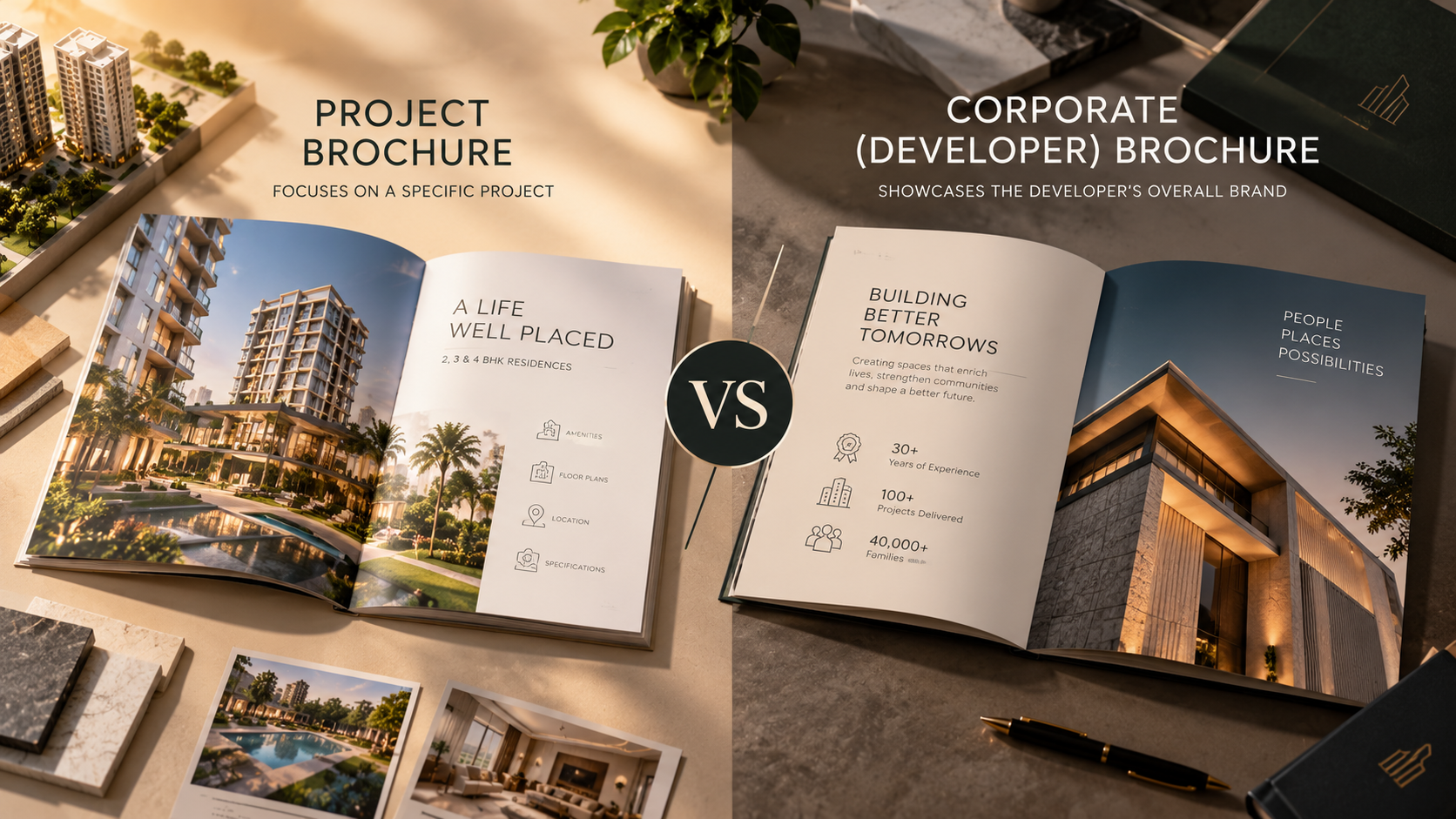
In a project brochure, location, master plan, floor plans, specs, amenities and price all come together to answer the question of whether a family should buy here. A corporate brochure speaks of faith in these people with history, delivered projects, land and approvals practice, leadership and qualifications. One is to speak to purchasers, the other to landowners, lenders, partners and the prospective buyer's family.
What to Include in a Real Estate Developer’s Company Brochure?
Arrange it as evidence in a rational order: the origin narrative, delivered, current and future projects, how land, approvals and construction are managed, the leadership team and external evidence. Prices, offers and live inventory belong into project material, since they date a real estate company brochure quickly.
Does each project need a different brochure from the developer brand?
Mostly because every project has its own geographical story, buyer and price reasoning that a company profile can't contain. The project brochure should still rely on the developer through the credibility page and the shared design language. A developer working on a single project can mix both in one document, provided each tale receives a defined part of its own.
How do you keep a project brochure on-brand with the developer’s brand?
Fix things that never change: logo usage, typefaces, colour logic, photographic style and tone of headlines. Then let each project space have its own name, treatment, accent colours and imagery within those parameters. Written brand guidelines make this replicable for designers and cities, so a customer who has seen one brochure recognises the next as part of the same family.
How often should you update a corporate brochure?
Whenever a fact changes that impacts trust: new delivery, a big award, a new city, a leadership change or a repositioning. For an active developer, a good rhythm is a yearly review and a full refresh every two to three years. If a corporate brochure still labels a finished project as ongoing, it reminds readers that nobody is tending to the company’s own story.
Share