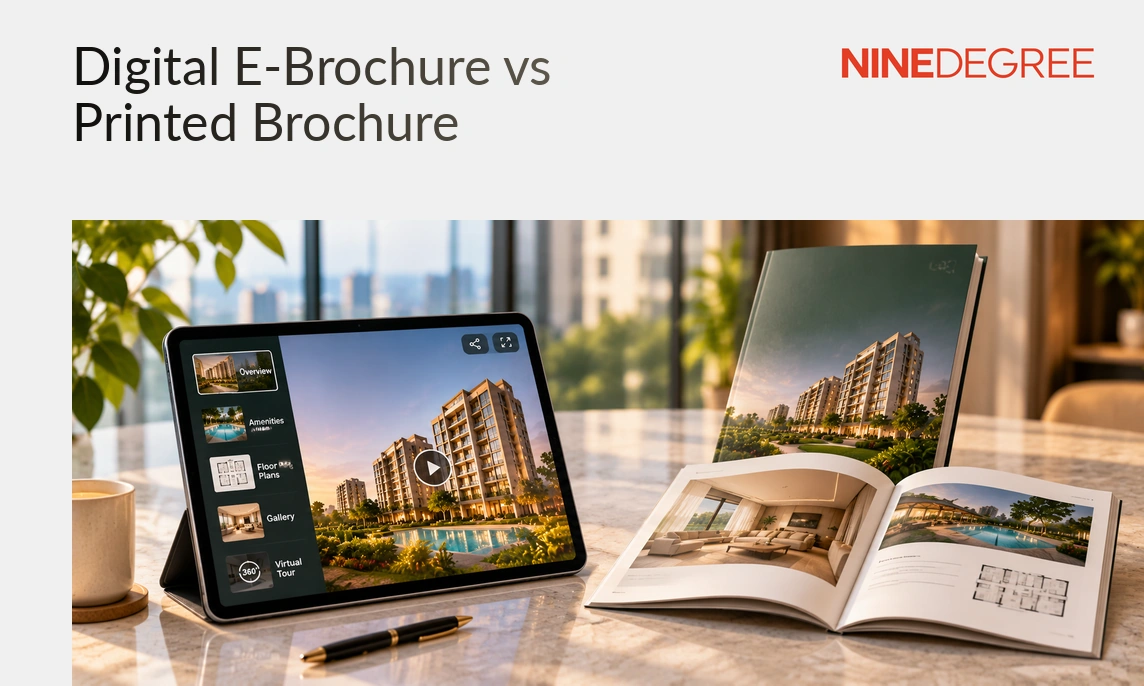
Digital brochures start more home sales in 2026. Print still helps close them. That’s the honest answer for most Indian projects. It holds for a plotted township near Jaipur and a tower in Pune.
Here’s why. Buyers meet a project on their phone first. A channel partner sends a PDF on WhatsApp. It goes to a spouse, then a father, then a brother in Dubai. Only then does anyone drive to the site.
So the brochure that does the early work is digital. Digital brochure templates help here, but only if they are built for a phone. Most are built for a printer. The printed copy shows up later, on the table during the family meeting.
Both formats have a job. Asking one to do the other’s work is the mistake.
How Buyers Read a Brochure in 2026
The brochure moved into the buyer’s pocket years ago. WhatsApp did that. India has well over 500 million WhatsApp users. Your leads are on it every day.
That changes who reads the brochure. It’s no longer just the person who filled the form. Now the whole family group reads it. Someone opens it on a cracked screen at 11 p.m. A cousin forwards it abroad without opening it at all.
Print plays a different role. A buyer who visits the site takes a copy home. It stays on the dining table for a week. Parents flip through it slowly and circle the floor plan with a pen.
Two readers, two moments. Plan for both.
Where Real Estate Brochure Printing Still Wins
Print is not dead at the site office. Not even close.
A walk-in buyer expects something to hold. Handing over a QR code after a forty-minute tour feels thin. Cheap, even. A heavy, well-printed book signals that the developer cared about finish. Fair or not, buyers read the same care into the building.
Print also earns its place at expos, channel partner meets and NRI roadshows. Older family members trust paper more than a link. In many homes, they have the final say.
The catch is shelf life. Prices move. Payment plans change. An elevation gets revised after approvals. Reprinting thousands of copies for one change hurts.
Keep the price list and payment plan on a loose insert. The bound book then stays valid for a year. Only the insert gets reprinted every few weeks. For more on how print still pulls footfall, read this guide to real estate print marketing.
Why Most Digital Brochure Templates Fail on a Phone
Most e-brochures are just the print file, saved as a PDF. That’s the problem.
A flat brochure PDF built on A4 landscape spreads looks fine on a laptop. On a phone, it shrinks to a thin strip. The buyer has to pinch and drag to find a carpet area. Most won’t bother. Sound harsh? Watch how often your own sales team zooms into a floor plan on WhatsApp.
Good mobile brochure design starts from the screen, not the press. Any electronic brochure template made for print needs a rebuild, not a resize. Here is what a phone-first file needs:
- Portrait pages, close to the shape of a phone
- One idea per page: location, one plan, one view
- Text large enough to read without zooming
- Room sizes typed big on every floor plan
- A file light enough to load on mobile data
- Project name, location, unit types and RERA number on page one
The last point matters most. Many buyers only see page one in the WhatsApp preview. Just a sunset render there? They scroll past.
Brochure reviews by teams like Ninedegree often start with one test. Open the file on a budget Android phone, over mobile data, in daylight. Every e-brochure template should pass that before launch. Then pair the file with a short message. Tell the buyer where to look first. These WhatsApp promotion message templates cover launch and follow-up wording.
Print or Digital: Which Should a Developer Fund First?
Fund the digital brochure first. Here is the decision most marketing heads face.
A launch is six weeks out. The budget covers a large print run or a proper e-brochure with a microsite. Not both. Pick digital. It reaches every lead on day one. Errors get corrected overnight. And it shows who is reading. Then print a small batch for the site office.
The table below shows where each format earns its keep.
Brochure Alternatives Buyers Actually Open
For many launches, the best brochure isn’t a PDF at all. Brochure alternatives have grown up fast.
A project microsite holds the same content and loads on any phone. It also tells you who visited. A flipbook keeps the page-turn feel of print, which suits premium towers. Video works differently. A ninety-second walkthrough often beats ten pages of renders. Buyers who struggle with floor plans still understand a camera moving through a living room.
3D tours go further, especially for under-construction projects. See how 3D visualization and VR walkthroughs support pre-launch sales.
Want online brochure examples worth studying? Pick three rival projects in your micro-market. Ask a friend to request their brochure on WhatsApp. Note what arrives, how fast, and what reads without zooming. That beats any gallery of e brochure examples.
Canva and similar tools let you create e brochure online. That’s fine for a first draft. It’s not enough for a launch. Buyers have seen those templates before.
What Digital Brochure Templates and Print Files Must Carry
Put the RERA details on page one, in print and on screen. Section 11(2) of the RERA Act covers every advertisement and prospectus. Each must show the registration number and the regulator’s website. A brochure counts. So does a WhatsApp PDF.
Some states go further. MahaRERA has required a QR code beside the registration number on project ads since August 2023. Other regulators set rules on where these details sit and how large they appear. Check your state before the design is locked.
Beyond the rules, a brochure must answer four questions fast. What is the project called? Where is it? What’s for sale? And what’s the price, or where’s the price list?
Miss one and the buyer might call a rival.
So, Which Works Better for Property Sales?
Digital wins on reach, but that’s not the full answer.
The e-brochure starts the conversation and keeps it going. Print closes the loop at the site office and on the family table. Projects that sell fast use both. The rule is simple. Build the digital file for a phone. Keep the print run small enough to update.
The best digital brochure design is often the plainest one. Start with the templates your team already uses. Open each on a budget phone. Fix what breaks. A real estate marketing company can build both formats around one story. Then the buyer sees one project, on paper and on screen.
Frequently Asked Questions
What is an e-brochure and how is it different from a printed brochure?
An e-brochure is a digital version of a project brochure. It is shared as a PDF, a link, a flipbook or a microsite. A printed brochure is a physical book handed out at the site office or at events. The e-brochure travels further and can be fixed in a day. Print feels solid and builds trust in person. Most projects need both, each at a different stage of the sale.
Do buyers still want printed brochures at the site office?
Yes, most do. A buyer who has spent an hour at the site expects something to take home. Older family members often prefer paper, and they read it slowly. Print also signals that the developer cares about finish. Keep the run small, though. Put prices and payment plans on a separate insert. Then a price change won’t kill the main book.
How should a real estate brochure be designed for WhatsApp and mobile screens?
Design it in portrait, close to the shape of a phone. One idea per page. Text should read without zooming. Put the project name, location, unit types and RERA number on page one. That is often the only page buyers see in the preview. Label floor plan rooms in large type. Keep the file light. Heavy PDFs stall on mobile data. Then test it on a budget Android phone.
What are the best alternatives to a PDF brochure (microsite, flipbook, video walkthrough)?
A project microsite is the strongest option. It loads on any phone, holds plans and videos, and shows who visited. That last part matters. A flipbook keeps the feel of turning pages, which suits premium projects. Short video walkthroughs explain a layout faster than renders. For under-construction towers, 3D tours help buyers picture the finished home. Many developers send a short video first, then the microsite link.
How do you track who opened a digital brochure?
A plain PDF sent on WhatsApp can’t be tracked. Once it leaves, it’s gone. To see opens, host the brochure as a link instead. Microsites with Google Analytics, document-sharing tools and flipbook platforms show opens, pages read, and time spent. Give each channel partner a unique link with UTM tags. That shows which partners send serious buyers. Push the data into your CRM.
Share