Nobody is looking at the flooring any more.
On paper, they came to evaluate a home. What they are really evaluating is a neighbourhood, and more precisely, whether the people already living there look like the life they want. The floor plan tells them where the sofa will go. The park at seven in the evening tells them whether they would belong.
That difference is easy to miss, because most master community marketing is built around the first question. Which leads to a more uncomfortable one.
In a large community, what if the most valuable thing a developer builds is the part that never appears on the price sheet?
Where the Real Decision Gets Made
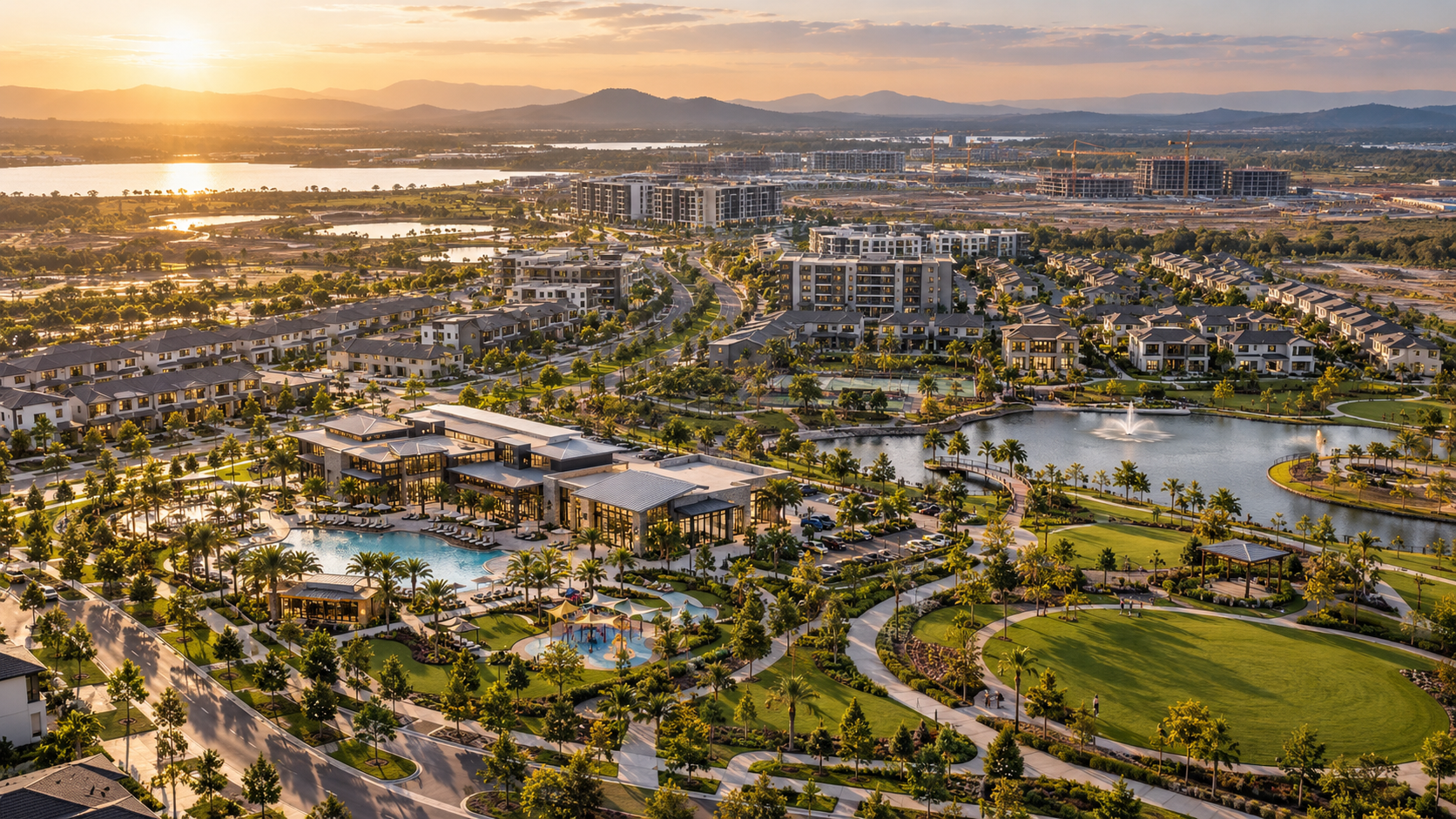
Working across townships and plotted launches, one pattern keeps repeating. The first phase is sold on imagination. Renders, walkthrough films, a masterplan with coloured zones and hopeful labels like "central greens" and "retail boulevard". Buyers are asked to believe in something that exists mostly as intention.
By the third phase, the conversation sounds different. Prospects ask to speak to someone who has already moved in. They want to know whether the school bus actually comes inside the gate. Some have joined a residents' WhatsApp group through a cousin before they ever meet a relationship manager. The questions get quieter and far more specific.
This is where marketing either becomes easier or becomes much harder. If early residents are happy, every new phase inherits their goodwill. If they are not, no media budget can outshout one unhappy neighbour in a family group chat.
A launch sells a promise. A living community sells evidence.
Why People Buy Neighbours
Why does the evidence carry so much weight?
Part of it is plain risk. A home is usually the largest decision a family makes, and most families do not trust themselves to judge construction quality, title paperwork or how the place will be maintained ten years from now. What they can judge is whether people who made the same decision two years ago seem at ease with it.
Part of it is identity. Where you live quietly tells others who you are, and it tells you too. A family looking at a township is also picturing their children's friends, the people on the morning walk, the faces at the first Diwali gathering. They are choosing a version of their own future, and they want to see someone already living it.
And part of it is memory. After visiting eight projects in a month, the specifications blur together. Everyone has a clubhouse, a jogging track, a gym with the same machines. What stays with a buyer is a feeling: the grandmother on the bench, the Holi photos someone showed on their phone, the child who waved from a cycle.
People forget amenity lists no matter how many times you include them in your real estate marketing strategy. They remember how a place made them feel about their future, and thats where the strategy of Nine Degree spends the most time exploring .
When the Developer Books the Musicians
Palava, Lodha's township on the edge of Mumbai, is a useful example because the developer treated the community as something to run, not something to hope for. Construction began in 2010 and the first residents arrived in 2014 (McKinsey). By late 2015, while the township was still young, Lodha had launched Palava Tarang, a monthly programme of theatre, music and dance with well-known artists, organised by the township's privately managed governing body for its 4,500-plus resident families (Lodha press release, November 2015).
It was not a one-off launch event. It sat inside a wider calendar the developer still describes today: the Palava Carnival, sports tournaments, seasonal festivals and masterclasses. The telling detail is where that description now lives. It appears on the sales page for Lodha Trinity, a newer project inside Palava, as part of the reason to buy (Lodha Trinity). Events organised for residents had become the marketing for the next phase.
Outside recognition followed. In 2017, JLL's Livability Quotient report ranked Palava first among ten emerging Indian cities and townships, judged on parameters that included governance, leisure and recreation, and real estate performance. Lodha's release on the ranking put Palava at 29,000 resident families and described its growth as threefold since 2009 (Lodha press release, September 2017).
Those figures come from the developer, and no one can neatly separate how much of that value came from a music series and how much from roads, schools and a mall. But separating them misses the point. Buyers never experience them separately either.
Read the sequence rather than the numbers. Programme the community early, let residents' lives become visible, then let that visible life sell what comes next. At that point the marketing no longer has to prove the idea, because the existing community does it every evening.
Most developers think of community as something that begins at handover, a facility management concern that sits after the sale. In a master community, it runs the other way. The value of phase four is being decided by how phase one feels to live in.
Community development is the true real estate marketing that compounds.
Why Does This Matters More Now ?
Look at residential advertising in any growing city today and the sameness is hard to miss. Similar renders, similar drone shots, similar promises of lifestyle and luxury. AI tools have made polished visuals fast and inexpensive, and we make plenty of them ourselves. But when every project can look beautiful on screen, a beautiful screen stops proving anything.
Buyers have adjusted. They verify. They read Google reviews left by residents, watch reels shot by people who actually live there, and look up the residents' association on Instagram. A township that can show a real Sunday morning holds something no render can manufacture.
This feels sharper in tier-two cities, where large townships are rising on the edges of places like Jaipur, Indore and Lucknow. Many buyers there are moving out of old neighbourhoods where everyone knows everyone. The building rarely worries them. Leaving that familiarity behind does.
So the question every master community has to answer has quietly shifted. After seeing ten projects in the same week, what makes a family trust the eleventh? Increasingly, it is proof that other families already do.
What Does It Change Beyond the Brochure?
If community is where value compounds, several decisions that sit outside the marketing department start to shape marketing outcomes.
- Phasing becomes a brand decision. Delivering the park, the school tie-up or the convenience store before the fourth tower tells buyers more than any brochure line about "thoughtful planning".
- Handover becomes a campaign. The first hundred families to move in are the most credible media a project will ever have, and their first month decides what they will say for years.
- Events change purpose. A Navratri evening in a half-occupied township is not a promotional stunt if it happens every year. It becomes a habit, and habits are what visitors notice.
- Even sales change shape. The most persuasive conversation on a site visit is often the one the relationship manager did not script, between a prospect and a resident walking a dog.
A campaign ends when the budget does. A community keeps making the case every evening.
The Asset Nobody Prices
Real estate is good at measuring what happens before the sale. Cost per lead, site visit ratios, conversion rates, booking velocity. There is no line item for a full park at seven in the evening, even though, in a master community, it may be the most honest predictor of how the next phase will sell.
This is increasingly the lens we use while working on township and plotted brands, and it leads somewhere slightly uncomfortable. In most launch plans we see, nearly all the spend sits before possession. For a master community, that looks backwards. Some of it belongs to the first year after handover, to the festivals, the resident stories and the small everyday proof that will do the selling for phase two.
Call it the Sunday evening test. If a stranger walked through the township at seven in the evening, what would they see, and would it make them want to stay?
The family on that Sunday evening was never really comparing flooring. They were watching the park, trying to decide whether they could see themselves in it.
A buyer cannot visit their own future. The closest they can get is watching someone else already living it.
Frequently Asked Questions
What is a master-planned community in real estate?
A master-planned community is a large development designed as a complete neighbourhood rather than a single building. It usually combines homes of different sizes and price points with open spaces, schools, retail, healthcare and everyday conveniences, all developed in phases under one overall plan.
How does community development increase property value?
A well-run community reduces uncertainty for buyers. When people can see happy residents, maintained open spaces and working everyday infrastructure, they feel more confident about the purchase and about future resale. That confidence tends to support demand for later phases and holds up the reputation of the whole development.
Why do buyers care so much about existing residents?
Most buyers cannot judge construction or long-term maintenance on their own, so they look at the people who have already bought. Existing residents act as proof that the developer delivered what was promised, and they help buyers imagine what daily life there will actually feel like.
How can developers build community before a project is fully occupied?
Delivering shared spaces and daily conveniences early in the phasing, running a smooth handover for the first residents, supporting a residents' association, and holding regular festivals or neighbourhood events all help a community form early. Consistency matters more than scale.
What role does marketing play after possession?
In a master community, marketing continues well after the sale. Resident stories, genuine reviews, event content and word of mouth become the most credible material for future phases, which is why the post-purchase experience deserves the same attention as the launch campaign.
Share


.png)