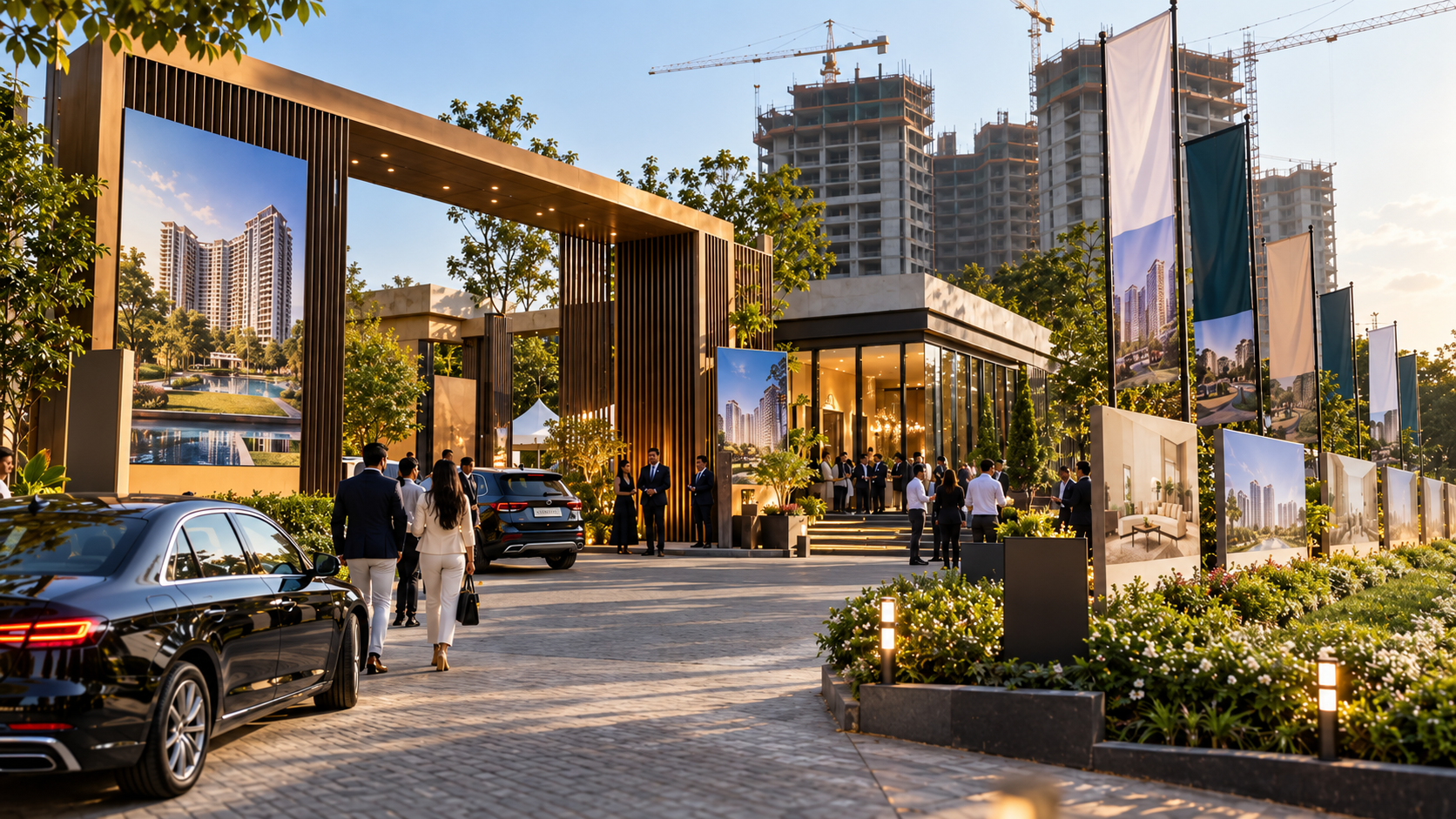
Site branding sells flats before the first slab is cast. That's not a slogan. In site branding, real estate buyers judge the builder by what stands at the plot today. Barricade, gate board, sales office, sample flat. Most buyers can't read a structural drawing. They can read a rusted tin sheet. And they do.
Here's the problem. Most developers treat the site as a work zone for two years. It becomes a sales tool for two weeks. Grey tin sheets go up first. Hoardings come late. Sales happen in a porta-cabin with plastic chairs. Then the launch ad asks buyers to trust a premium price.
This guide covers each piece in the order buyers meet it. Plus when each one should go up.
Why Real Estate Site Branding Sells Before the Building Does
The plot is your first brochure. Every buyer who drives past is reading it. A clean, lit barricade with a clear name says the builder plans ahead. Torn flex hanging off one corner says the opposite. Fair? No.
But Indian buyers have watched projects stall for years. They look for signs of trouble, and the site is where they look.
Real estate development branding usually starts on screens. Logo, website, Instagram grid. The site gets whatever money is left. Flip that order. Someone who passes the plot on the way to work sees it hundreds of times before launch. No ad buy gets that for free.
What Construction Site Hoardings Should Show
A hoarding is not a brochure. Not even close. A driver gets a few seconds with it, less at a busy signal. That leaves room for one idea, the project name and a location cue. Seven words in the headline is a good ceiling.
Skip the features list. Nobody reads "clubhouse, gym, pool, jogging track" at a traffic light. Pick the one thing a rival can't claim. A view, a metro stop, a school next door. Say that, in big type. The same one-message rule drives print ads that still bring site visits.
Then the compliance strip. Under Section 11(2) of the RERA Act, every ad shows the registration number and the RERA website. Hoardings count. Maharashtra goes further. A MahaRERA order from April 2025 puts a QR code in the top right corner of every ad. Plan that space in the first layout. Squeezed in later, it wrecks the design.
A hoarding that works carries five things, and nothing else:
- One headline, under seven words
- Project name and a location cue
- One proof point a rival can't copy
- RERA number, RERA website, and QR where the state asks
- One contact route, a number or a WhatsApp short code
Construction Barricades Are Your Longest-Running Ad
Most developers see the barricade as a safety cost. Wrong. It's two to three years of free media on your own frontage. Many sites need a tall one anyway. The Environment (Protection) Amendment Rules, 2018 ask for wind-breakers on projects with environmental clearance. That applies in cities that breach air quality limits. Height? A third of the building, up to 10 metres. That's a lot of wall. Use it.
Treat the barricade like chapters, not one long poster. Every 20 metres, a new panel. Top-floor view, master plan, then a build update that changes monthly. "Tower B, 9th slab done." That panel does more for trust than any tagline. Light the whole run, too. Dark at 7 p.m. means you lose the evening commute.
Two small things from the field. Reds and magentas fade first under the Jaipur sun. Reprint before they wash out. And keep the bottom two feet dark, since monsoon splash ruins white flex in a week. A good real estate marketing company plans barricade, hoardings and sales office as one system. Not three vendor jobs.
Real Estate Office Branding: From Site Office to Experience Centre
A site office and an experience centre are not the same room. One holds a desk, a cost sheet and a calendar. The other walks a family through the project in twenty minutes and lets them feel it. Real estate office branding turns the first into the second. The payoff shows up in price. Buyers who feel looked after haggle less. That's how brand experiences help premium projects hold their rate.
Start at the car. Where does the family park, and who meets them? Then the wait. Chai within two minutes, a clean washroom, a corner for kids. Sound basic? Ask any site head how many Sunday visits end early because a child got bored.
Next comes the story wall. Show drive times on the location map, not "near the airport." Mark north on the master plan model. Half the questions in Jaipur will be about vastu. Keep cost talks in a separate, quiet cabin. Money needs a door. And match the hoarding. Navy and gold on the highway shouldn't lead to a beige cabin.
Sample Flat Ideas That Close the Imagination Gap
Buyers don't buy floor plans. They buy the feeling of standing in the living room. The sample flat is where that happens. Or doesn't.
Most first-time buyers can't read a 2D plan. Carpet area is just a number until they stand in it. Undersized furniture is the oldest trick in the book. Skip it. Buyers find out at possession. Then they tell the whole family WhatsApp group.
Here's what a sample flat that earns trust gets right:
- Real-size beds and sofas the buyer would own
- RERA carpet area for each room, taped on the floor with a small sign
- One room left bare, showing plaster, wiring and waterproofing
- Fittings labelled by brand: tiles, switches, taps, windows
- The real view, or a drone photo taken from that floor
- An "upgrade" tag on anything not in the spec sheet
That last point matters most. Marble in the sample and vitrified tiles at handover? The buyer feels cheated. Tag it. And if the sample flat isn't ready, push the launch. A render on a TV doesn't do the same job.
How Early Should Site Branding Go Up?
Earlier than most developers think. Months, not weeks. One hard limit first. Section 3 of the RERA Act bars any advertising, marketing or booking before the project is registered. So before registration, the barricade carries the developer's name only. No project offer, no booking number.
Once that's clear, the order looks like this:
- Before RERA registration: developer brand on the barricade, clean site, no sales message
- On registration: full barricade wrap with project name, RERA number and QR
- 6 to 8 weeks before launch: hoardings on the two or three approach roads
- 4 to 6 weeks before launch: sales office opens for previews
- Launch week: sample flat ready, gate signs and lighting checked
Sawai by Akshat in Jaipur shows how this plays out at the ultra-luxury end. Sample flat viewings stayed appointment-only. Premium outdoor ads and an invite-only launch leaned into that exclusivity. Ninedegree created the brand from a blank page. About 40% of the project sold within six months. Read the full Sawai case study.
Property Development Branding Starts at the Gate
Here's an honest take. Most launches don't fail on the ad. They fail at the gate.
A buyer drives in after seeing a great hoarding. No sign on the approach road. The guard doesn't know where the sales office is. Inside, the sample flat smells of fresh paint. Each gap costs a little trust. Property development branding is the job of closing those gaps, one at a time.
Walk the site the way a buyer would. Main road, gate, parking, sales office, sample flat bedroom. Go on a Sunday afternoon, when real families visit. Note everything that feels off. Fix it. Then launch.
Frequently Asked Questions
What is site branding in real estate?
Site branding in real estate is every branded surface a buyer sees at the project site. Barricades, hoardings on approach roads, gate signs, the sales office, the sample flat. Its job is to make an under-construction plot look planned, active and trustworthy. Good real estate site branding uses the same name, colours and message as the project's ads. A buyer should recognise it from the highway to the sample flat bedroom.
What should construction site hoardings show?
A site hoarding needs a headline under seven words. Then the project name and a location cue. Add one reason to pick this project over its rivals. Section 11(2) of the RERA Act also requires the registration number and the RERA website address. In Maharashtra, add the MahaRERA QR code in the top right corner. Give one contact route, a phone number or a WhatsApp short code. Skip long feature lists. Drivers only get a few seconds.
How do you brand a sales office or experience centre?
Plan it as a route, not a room. Start with parking and a greeting at the car. Give families a clean waiting area with chai, a washroom and a kids' corner. Then walk them past a location wall with drive times. Next, the master plan model with north marked, and a live build update. Keep cost talks in a separate cabin. Match the colours, type and tone of the hoardings. The brand should feel like one project, not three vendors.
How early should site branding go up?
The barricade can go up as soon as the site is fenced. Until RERA registration, it should carry only the developer's brand. Section 3 of the RERA Act bars advertising and booking before that. Once registered, wrap the barricade with the project name, RERA number and QR. Hoardings go up 6 to 8 weeks before launch. Sales office, 4 to 6 weeks out. The sample flat should be ready by launch day, not a week after.
Share